
In one of Zurich’s oldest-surviving buildings – dating to 1260 – chef Markus Stöckle has opened one of the city’s newest restaurants.
Marküs opened in early September and is a vibrant homage to Stöckle’s decades-spanning career, which spans from early years in his home in Bavaria to his time at Heston Blumenthal’s genre-defining The Fat Duck. Most recently, Stöckle headed up the now-closed Rosi in Zurich, which re-imagined the traditional Bavarian inn.

At Marküs, the level of hospitality is being turned up a notch, offering a single tasting menu (with vegetarian adaptation) that marketing materials are billing as ‘unrestrained.’ Stöckle has forged strong relationships with sustainable suppliers, and is emphasizing local ingredients and dishes, such as an interpretation of Swiss comfort classic Älpler Makkaronen, fish sourced directly from Lake Zurich, and fresh sansho peppers from the city’s surrounding region.
Many vegetables will be grown exclusively for the restaurant in nearby farms. Stöckle’s time working in Japan is honored too – albeit with a local edge – via tofu made by tofu master Yumemi Ito using Swiss soybeans. Stöckle is also placing heavy emphasis on an in-house fermentation and pickling program, developed in partnership with ETH Zurich – the city’s public university.

While tasting menus that hold provenance in such high regard can be known to veer into being inhospitably earnest, Stöckle has declared from the outset that his latest project will be characterful and fun.
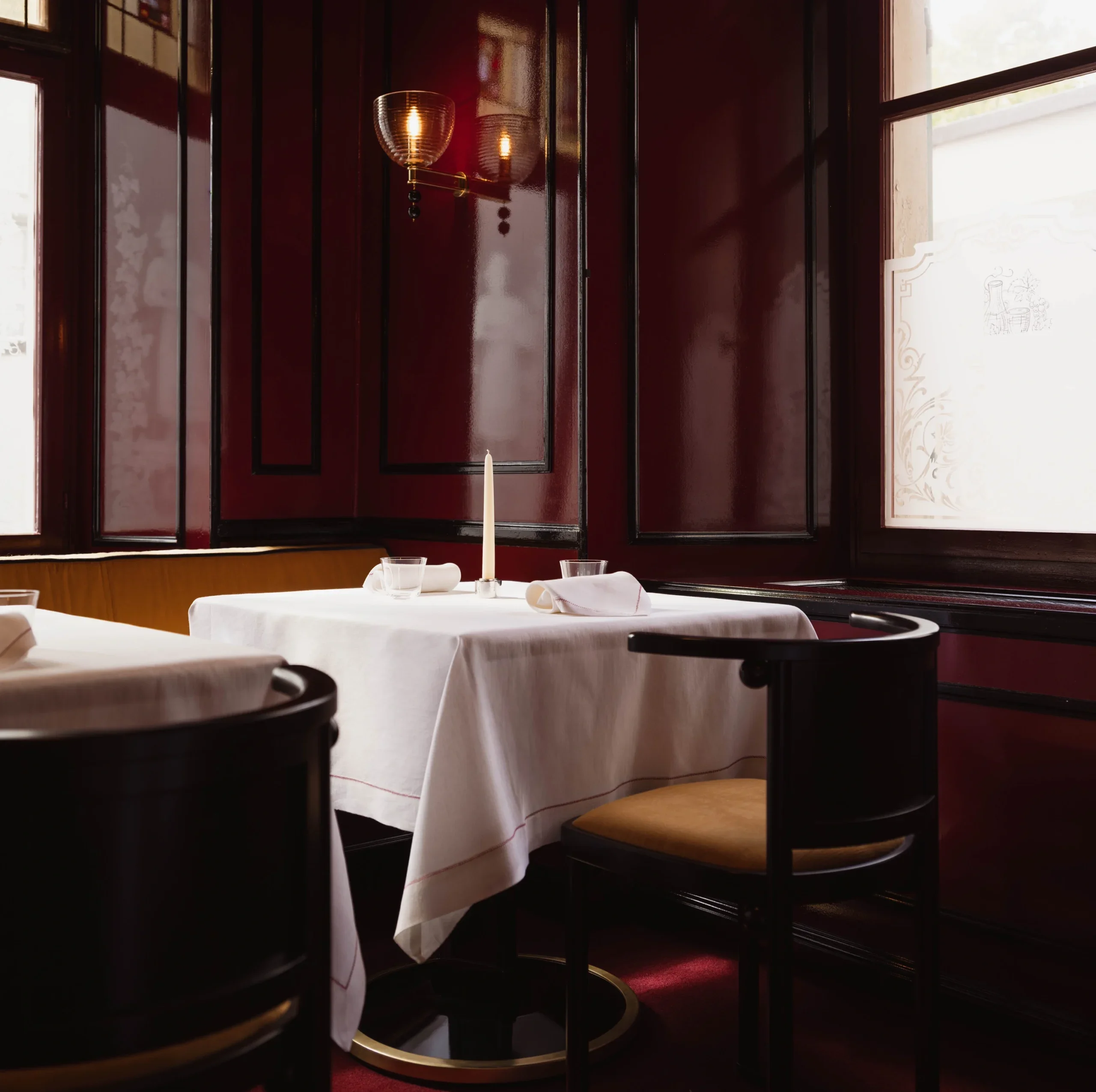
Studio Dragó handled the design, working sensitively to both celebrate the building’s vast history while also injecting modern identity. To achieve this, the Italian firm focused on uncovering and restoring period elements that had been carelessly concealed during the building’s long life.

On the lower level, the walls are crimson-red lacquer; upstairs, the original 13-century wood panels still remain in the exclusive-use private dining room. Table settings nod to the refined nature of the restaurant, with crisp white linens simply laid with a single candle. Swiss ceramicist Lilly Haas has created the tableware: each of her pure-white porcelain pieces are made by hand and individually numbered.
“It’s a true honor to cook in this location and feel the energy and history of the building”, says chef Stöckle. “There’s an incredible sense of freedom here for me. I see myself as a caretaker of a 700-year-old story of hospitality, and I can’t wait to share our vision with our guests.”