


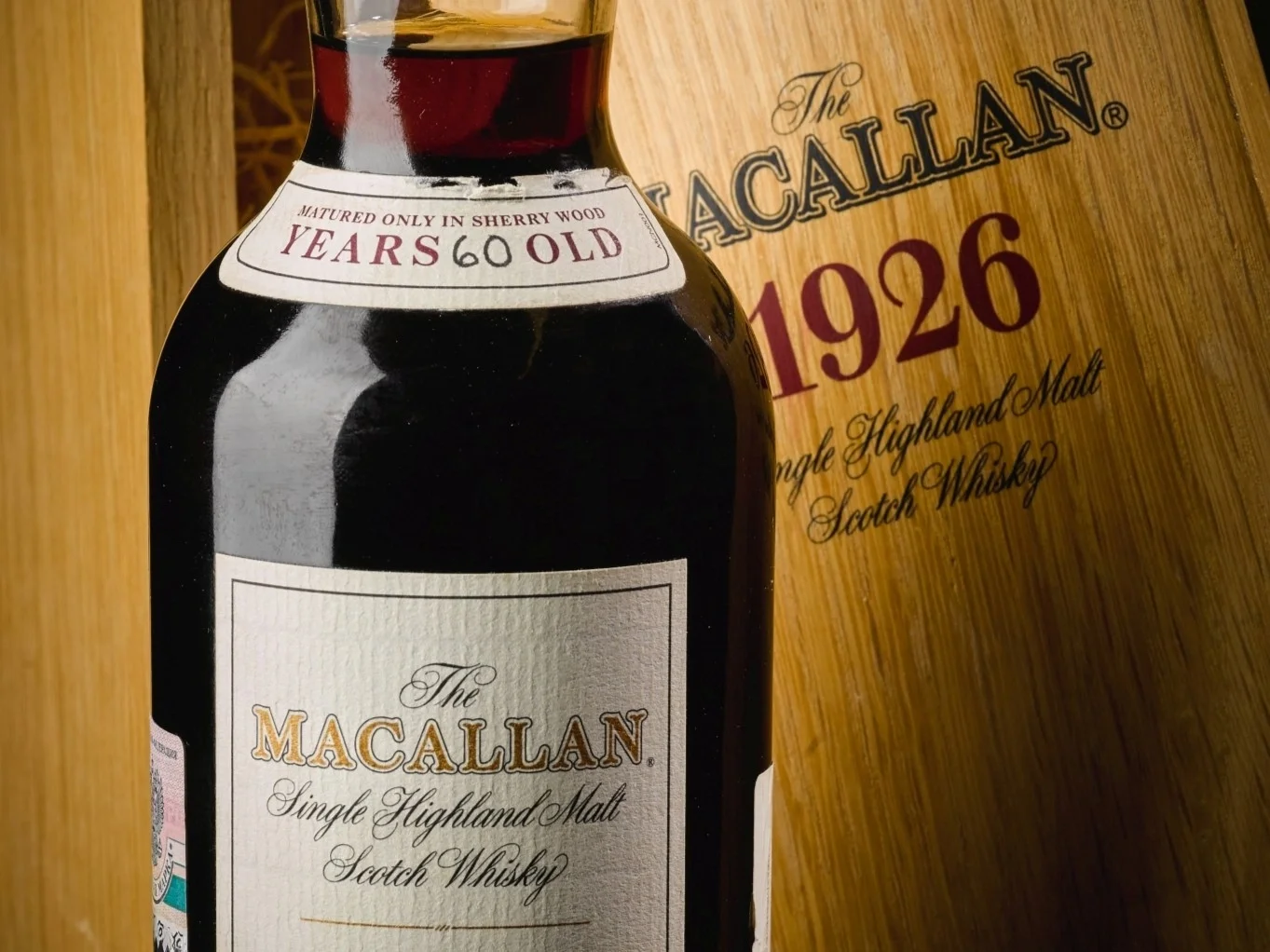
What’s the most expensive whisky in the world? If you’re even a little into knowing your Scotch – or have read our own list – you won’t need to phone a friend.
Seven of the 10 most expensive bottles sold at auction are Macallans, making the Speyside distillery the rather safe answer.
But it’s specifically the Macallan 1926 that has something of a habit of breaking records. On October 9, it will get another chance to do so when Sotheby’s offers a bottle of the legendary vintage at Live from The Macallan Estate, the auction house’s first sale at the Scottish distillery.
The Macallan Fine & Rare 60 Years Old 1926 carries an estimate of £1.7m to £2.2m ($2.3m to $3m), putting it level with the current auction record for any bottle of whisky. That record was set by another Macallan 1926 – the Valerio Adami edition – which sold for £2.2m ($2.7m) at Sotheby’s London in 2023.
There are only 40 1926s to go around. Distilled in 1926 and matured for six decades in a single sherry-seasoned oak cask, No. 263, they were bottled in 1986 as 60 Year Olds. At the time, it was the oldest Scotch ever bottled.

The 40 bottles were divided between several editions: 12 carried labels designed by Sir Peter Blake, another 12 by Italian artist Valerio Adami, and up to 14 were released as Fine & Rare. Two were left unlabelled, one of which was later hand-painted by Irish artist Michael Dillon. “The Fine and Rare label is arguably the least coveted,” says Alex Martin, editor-in-chief of World of Fine Spirits. “It’s the distillery’s standard design; the others are works of art.”
Sotheby’s Jonny Fowle, global head of whisky and spirits, takes a different view, describing it as “the cornerstone of The Macallan’s celebrated Fine & Rare Collection” and its “purest expression of the 1926 story.”
At this level, their disagreement is beside the point, as the 1926’s value has long since moved beyond the question of which label looks best. As Martin puts it, there is “an anchoring effect at auction, with every new record becoming the new baseline for what collectors expect to pay.”

Fowle says there are four things collectors should be examining when a bottle reaches this level: “rarity, provenance, condition, and significance.” It is the latter that can be harder to quantify. “For exceptional bottles, cultural and historical importance can be just as influential as age or scarcity,” he says.
The question now is whether this particular 1926 can push that market close to that $3m estimate. Fowle is, understandably, cautious about predicting the outcome. “Ultimately, collectors will determine the value on the day,” he says. But this is the first 1926 to appear at auction since the record-setting Adami sale in 2023, and the timing of coinciding with the centenary of the vintage’s distillation makes it difficult to ignore.
The Macallan Estate has never hosted an auction before, and bringing the sale to Speyside puts the bottle back in the landscape from which its story began. “There is something very special about offering these whiskies at the place where their story began,” says Fowle. “Hosting the sale in Speyside creates a direct connection between the whiskies, their heritage, and the collectors who cherish them.”

Martin sees another potential advantage in bringing the bottle to The Macallan Estate. Rather than selling it in one of the traditional auction centers, it could broaden the pool of potential bidders. “Lots of press in the build-up means it is likely to attract every whisky collector intent on buying it, and generalist collectors from outside whisky too,” he says.
That second category is increasingly important to the 1926’s story. Martin argues that it has become sufficiently recognizable to exist beyond the whisky world altogether. “Some bidders will have no interest in whisky, but still want the 1926 because it is the standout collectible spirit.”
And, in the world of ultra-high-end collecting, $2.7m may not be quite as intimidating as it sounds. Martin points to a Pokémon card that sold for around $16.5m in February as evidence of the sums being spent elsewhere in the contemporary collectibles market. “It only takes two people used to paying much higher fees to come in, and the price goes to the next level.”


