

Collectors flocking to London for Frieze and PAD this October should stray slightly off course to visit Wings & Tales, a solo show staged by the New Delhi-based Vikram Goyal Studio in a Georgian townhouse just minutes from Berkeley Square. Like a richly decorated home, the exhibition unfolds across two rooms, showcasing collectable design, which takes inspiration from nature and the mythical creatures that animate the great Indian epic, the Ramayana. Goyal calls it a “dialogue between spirituality, nature, and craft.”


“I wanted to welcome people into a salon, or baithak, and create an island of calm amid the frenzy of Frieze,” says Vikram Goyal, whose atelier is renowned for innovative artisanship and contemporary design that explores Indian heritage crafts such as repoussé metalwork and pietra dura. “Traditionally, the baithak — a formal Indian drawing room — was a place for gathering, conversation, and exchange. I wanted to bring that spirit here, allowing people to spend time with the work rather than simply pass through it.”
In this vein, the lunch preview invited guests to soak up the surroundings and enjoy canapés from London restaurant Gymkhana while listening to the American design curator, historian, and author Glenn Adamson, in conversation with Goyal, whom he refers to as the “William Morris of 21st-century India” — not just for the breadth of crafts that he directs and oversees but also for “his strong moral compass and high standard of employment” for multi-faith artisans at his workshop.

Goyal began his career in finance in New York after studying engineering and development economics at Princeton, but for the past two decades has been reframing Indian craftsmanship for a global audience via his eponymous studio. Experts in repoussé metalwork, which Adamson says Goyal has not only revived but “elevated to a standard not seen for the past 200 years,” his team also expanded into new materials and techniques with hand-knotted rugs and brocade upholstery, made by a specialist atelier in Varanasi.
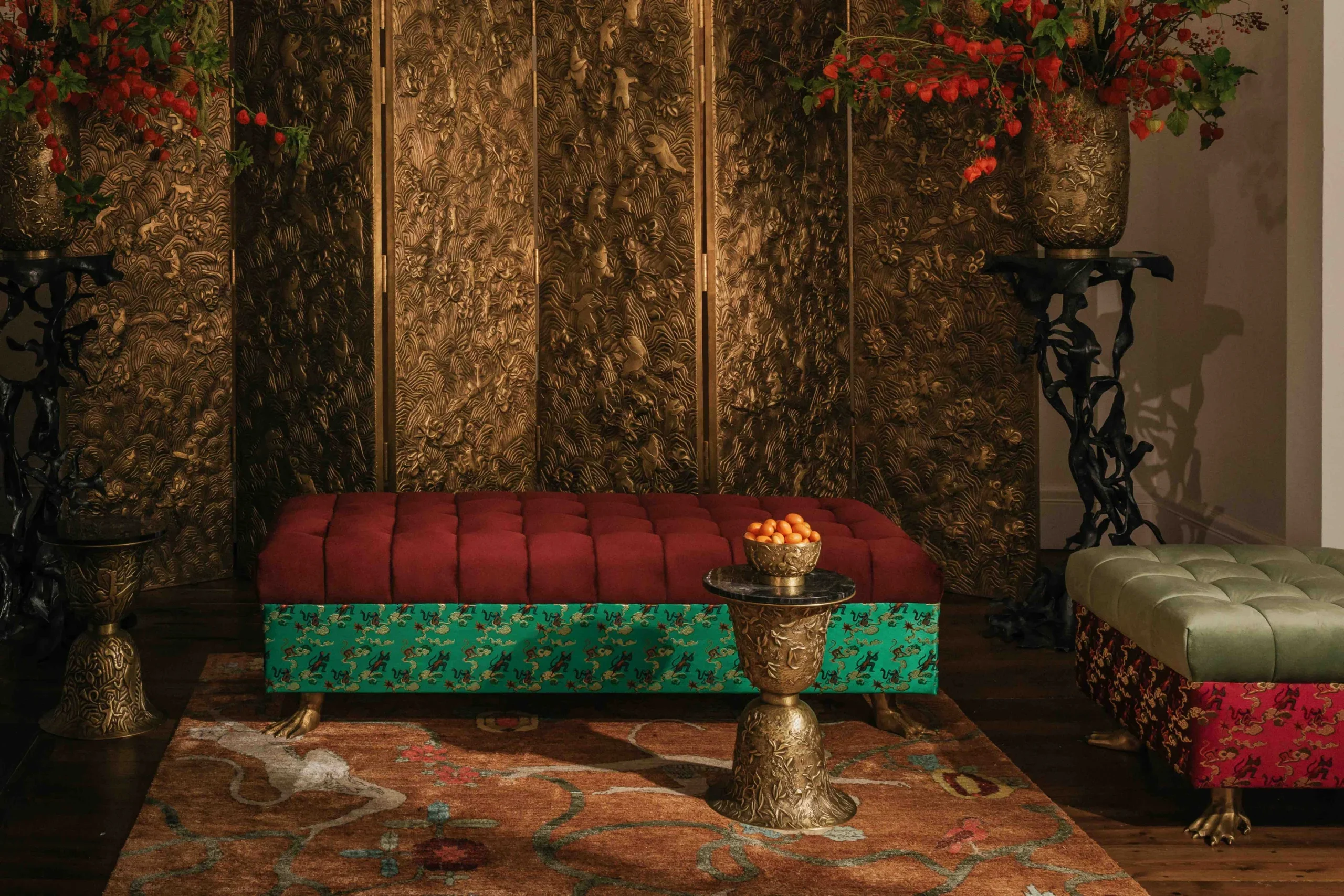
Guests sat on exuberantly hued hand-embroidered silk brocade and velvet seating supported by cast-bronze animal feet, surrounding Samarkand-style rugs woven from recycled sari silk. Around the room’s perimeter, organic repoussé brass screens and tables support large, intricately decorated vases — all featuring characters and scenes from the Ramayana — with oversized displays of rosehip and Chinese lanterns by Blooming Haus adding flora to the fauna. Often compared to the Iliad and Odyssey, the sacred Hindu poem tells the tale of Prince Rama, exiled from his kingdom, who goes to war to rescue his wife after she is kidnapped by the demon king Ravana.


“My earliest memories of the Ramayana go back to when I was five,” recalls Goyal. “My parents would take us to a three-hour Ramayana play every year, and I was completely enthralled. These were beautiful productions, with elaborate costumes, hair, and makeup, and I remember being fascinated by the theatricality. There were extraordinary half-human, half-bird creatures — mythical, magical beings that opened up an entirely different world.” For many Hindus in North India, the festivals of Dussehra and Diwali commemorate the Ramayana’s narrative of good triumphing over evil and Rama’s homecoming, respectively.
Adamson refers to the body of work as a “cross-cultural synthesis” and although Indian crafts are at the forefront, this collection is enriched by Goyal’s international approach. “The carpets represent land, air, and sea with creatures emerging through earth, waves, and clouds,” Goyal says, noting how the recycled nature of the silk adds variation of color and texture. “We looked to Indian and Ottoman miniature paintings, as well as Chinese embroidery and porcelain. There are also strong affinities with Art Deco. I enjoyed bringing these diverse influences together to create a cohesive visual language.”
The detailed repoussé screens, bowls, and vases are particularly impressive when you discover that the artisans work “half-blind” — as Goyal calls it — hand-hammering brass sheets into relief from the reverse side before “chasing” the front, which means sharpening and refining the design. Pieces are very much crafted, rather than tightly designed, with the studio working in a highly collaborative, iterative way. The design team create sketches inspired by the big idea, in this case the Ramayana, and these are then passed to the craftspeople with an ongoing back-and-forth process. “We allow the artisan to breathe life into the work, they bring a depth of expertise and knowledge that can’t be replicated, and their input often enriches the final work. I like that element of surprise,” says Goyal.


A recurring motif, appearing throughout the scenography, is the monkey. “They embody the sense of playfulness, camaraderie, and community that lies at the heart of the collection”, says Goyal. Beyond the appreciation of the crafts, he hopes visitors will perceive a spiritual dimension to the work and enjoy the narrative. “In India, animals are revered and understood not simply as creatures within the natural world, but as spiritual beings, connected to ideas such as the transmigration of souls. I want visitors to reflect on the interconnectedness of all living beings. I also hope people take away some of the lessons contained within Indian mythology and poetry, particularly the Ramayana — ideas of friendship, loyalty, and compassion, and of how we relate to the world around us.”
Continuing the storytelling theme, Wings and Tales will also host a series of literary salon-style events featuring young writers Sam Dalrymple, a non-fiction author of Shattered Lands and the Travels with Samwise Substack, and Gurnaik Johal, author of the fictional Saraswati.
Wings and Tales, October 13-16, 10am-6pm, 7A Grafton Street, London, W1S 4EJ