

Last fall, Mike Hansen cursed the weather as he showed a potential buyer a few properties, all of them classic Sonoma vineyards up for sale.
Hansen has been the go-to agent there for the past four years. The son of two winemakers, he also farms 14 acres of Chardonnay vines himself. It was only October, but the weather was terrible, he says. “We went to a few spots, and it couldn’t have gone any worse — it was dumping rain.” They trudged through 10 vineyards without a spark of interest from the buyer.
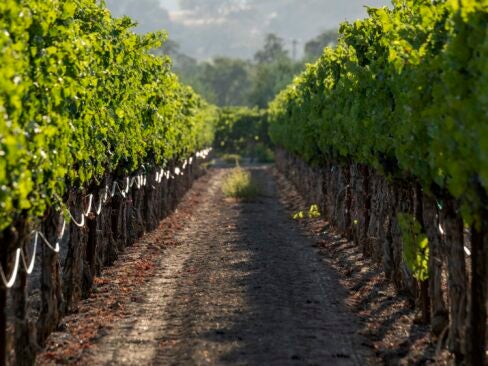
One property, though, was off-limits that day since no one was available to show it: the 19-acre Giusti Ranch in Forestville, Russian River Valley. Undeterred, he made plans to view it with his client a few weeks later. The sun shone, and Vaneet Wadhawan was instantly smitten. “I fell in love with the vineyard, and I told him I wanted to close before the end of the year,” says the 50-year old tech exec who lives in the Bay Area with his wife and two teenage children. “It fit all my criteria: it makes premium wine, the soil is good in this area, and one side was an Airbnb, with a view of the Wine Country oaks, that had been running successfully for five years.” On December 15, they closed the deal; Giusti Ranch sold for $4.24m, or around 15 percent below the list price.
Related article: Do You Need an AI Wine Cellar?
In the past few years, vineyards like this one have increasingly become highly desirable assets, requiring less effort — and negotiation — than springing for your own sports franchise, and with greater personal upside than owning a boutique hotel, where, however comfy the bed, it doesn’t compare with quaffing the first glass of a vintage made to your exact specifications. And not least because most are relative bargains. Wadhawan’s 15 percent discount on the asking price isn’t unusual. In parts of the winemaking world, even storied vineyards like this one are trading at below asking price, if they sell at all. “It’s a buyer’s market without a doubt, and a hard one, too,” says Hansen, who’s based at the Sotheby’s office in Sonoma.
The slump in vineyard values is down to two key factors. Wine consumption has cratered, both nationally and internationally. In 2024, global consumption fell 3.3 percent to 214 million hectoliters — or down 14-15 percent versus 2018; these are levels not seen since the late 1950s, per the International Organization of Vine and Wine. In the US, 29 percent of the population were wine-drinkers in 2025, per the Wine Market Council — nine million fewer than two years earlier.

Pair those headwinds with the race to raise prices: the Fine Wine 100, a benchmark index from data tracker Liv-Ex following the world’s most sought-after wines, shows a rise in value of 120-150 percent over the past 10 years alone. Such a price uptick might not be sticker shock for seasoned, older drinkers, but younger oenophiles — a crucial pipeline to keeping the industry thriving, long-term — are unlikely to spring for the same premiums. This type of generational lopsidedness drags down the market overall. “It’s not caught up with that generational handover of wealth,” Hansen explains, “so we have seen historically low pricing [of land].”
Indeed, the age of most vineyard buyers remains relatively high, in the main. Alison Graham of Barnes International, another expert in the sector, believes that while Wall Street bonuses might drive some of the thirtysomethings into buying for “prestige, the lifestyle brand, entrepreneurship,” there’s far more activity in those aged 45 and older — who think of vineyards in terms of legacy and succession planning.
Some noteworthy farms in his area have transacted as low as $110,000 per acre, when the minimum for valley-floor land has long been $250,000. “There’s certainly more supply and what is there spends longer on the open market than I’ve ever seen,” says Hansen. It might be tough for vintners right now, but that also means there’s never been a better time to score a deal on that dream vineyard. But where to start?
Related article: The Most Beautiful Wineries to Visit in France
Vaneet Wadhawan was flummoxed when he set out. His interest in wine took off during a visit to Italy in 2010 where he sampled bottles around the country. Returning home, his passion grew, but it was only during the pandemic that he began to wonder about acquiring his own parcel of land. “We had some time to think — and one of the updates Apple did? It had a really nice vineyard as a screenshot,” he recalls.
So he started sketching out what would make a vineyard a smart investment. A contract with an established winery for whatever it grew was vital: the glut of production, he recognized, would make selling juice on spec on the open market both arduous and likely low-margin. A charming setting with potential revenue from overnight guests, diversifying its income, was also essential. Giusti Farm checked both boxes: it has long supplied Pinot Noir to Kosta Browne (while making its own estate-grown wine, too). The appealing price, at 15 percent below asking, clinched Wadhawan’s decision. Still, the buyer wasn’t simply taking over the family farm for hard-nosed reasons. “There’s a great story, and he enjoyed that side of it. He was dreamy-eyed about the wine industry at the time, and hopefully still is,” says Hansen.
Wadhawan himself treats the recent slump as a mere blip. “Wine is evergreen. It’s been part of the culture for thousands of years,” he says. “It’s cashflow positive and at the same time, I’m enjoying my wine. I’m just happy to be a part of the culture.”

Prices in Northern California make it especially appealing. Hansen says that Russian River Valley vineyards like Giusti can only eke out $125-150,000 per acre if they have a purchase agreement attached; in lower-profile regions like Petaluma Gap, for example, uncontracted fruit-growing land might only fetch $15,000 — so low that buyers might consider coming in and ripping out vineyards to deed the land to pasture instead. It might be a relative bargain to buy in California but for many, there’s greater romance in Old World hotspots.
Alison Graham from Barnes in New York has handled several transactions like this in the past few years; she receives around five inquiries each month.
One recent cold call came from a thirtysomething Manhattanite from a wealthy family who specifically inquired about Tuscany. “She wants the lifestyle — to move there, to produce her own wine of quality, to entertain her friends,” says Barnes. Other stipulations: close enough to a major town to drive there easily, and between €3-5m ($3.45-5.8m). “There is so much for sale that she isn’t going to struggle,” says Barnes. “You’ve got an oversupply of very, very good wine but you’ve not got enough demand.” If only she’d be open to France, as there’s a family there who bought a working, prestigious Bordeaux winery on 24 acres for €3.2m ($3.667m) four years ago. “They decided the lifestyle is not for them, so they’re coming back to America, and it’s currently on the market for €900,000 ($1.03m). And they cannot get a buyer.”
Graham adds that transfers between parents and children are increasingly triggering sales in Europe — “after the 15th generation, the next one doesn’t want to do that for a living. It’s happening across the board” — which further compounds the slump in alcohol sales. Then there’s the considerable impact of President Xi’s anti-corruption crackdown; in the past, prestige bottles of red wine were often used as bribes. “We saw the Bordeaux market ripped apart for the last two or three years,” says Graham. That’s one of the reasons why Bordeaux — at least, beyond the trophy tier — is “quietly struggling”, she says, alongside non-prime Napa and Sonoma and Marlborough in New Zealand; all of them can offer major potential upsides for the right buyer.
The other issue, of course, is climate change. Take Champagne, where some vineyards are struggling — not to sell their product, but to grow grapes as they have for hundreds of years. “The best Champagnes aren’t coming out of there anymore,” Graham notes, “They’re coming from [the area] south of London.”
Even if demand for acreage under vine in mainland Europe and America is sluggish, there’s one undervalued terroir that experts say will likely surge in prestige (and pricing) before much of the rest of the market bounces back: the English countryside. Climate change has unlocked the potential of the land, which is geologically on a par with the best of Champagne. And it shows: Nyetimber’s Blanc de Blancs 2016 magnum took the top slot at the International Wine Challenge in London last fall, the first time a non Champagne was named Champion Sparkling Wine. Yet parcels are not yet trading at excessive premiums, and have huge potential to appreciate — at least according to Rupert Coles. The chartered surveyor-turned-estate agent is the son of a dairy farmer, so he understands the economics, and challenges, of running any agricultural business; he’s become the most trusted wrangler of English vineyards as the industry has boomed over the past decade.

Coles says that vineyard transactions have grown from 20 percent of his business 10 years ago to at least half today. The big decision when buying in a new region, like England, is between land already under vine and raw plots — a cost difference of £30-40,000 ($39,600-52,800) versus £12-20,000 ($15,900-26,000) depending on the caliber of the terroir. If you opt for the latter, it’s vital to plan for a consultant to help set up the plantings and manage them. Look for areas that traditionally produced hops for the beer industry, like Worcestershire and Herefordshire. Essex is also a hotspot for that approach, around Crouch Valley, with its clay-heavy soil and hot, relatively dry climates. Pioneering vineyards there include Danbury, says Coles. “It’s not surrounded by the nicest towns, but it’s producing the best Pinot.”
Most buyers in England, though, are looking for plug-and-play plantings in picturesque settings, just as Wadhawan was in Sonoma. The South Downs, from Eastbourne to Winchester, is a magnet for them. “They come looking for wines and fall in love with the place,” Coles explains. For always-on types with constant demands on their time, vineyard life offers an antidote. “The cadence of walking up and down a vine row, pulling up some weeds, allows them to fall in love with it.” Don’t expect bargains if vineyards come up for sale there, he warns. “If something’s special, be prepared to work hard to buy it.”
Don’t underestimate the legal intricacies, too, particularly when buying abroad. There were so many inquiries around vineyard-buying at the private client-focused law firm Forsters that it set up a division to deal with them. Its first vineyard deal was back in 2015, says Victoria Salter-Galbraith, who leads the team. “It was seen more as a gentleman’s hobby at that point, but so much has changed in the last 10 years.” She, too, suggests the first question any would-be buyer should ask, in England or elsewhere, is what kind of land they’re planning to buy: even if the vines have been growing for decades, has it been run commercially? “Are you buying an up-and-running company? That’s different to buying some land that has, or is going to have, some vines on it.”
Realistic expectations (of yourself) are paramount. How hands-on do you intend to be? As the American family in Bordeaux learned, it’s a costly mistake to misunderstand the role you will play. “Are you going to make the wine yourself?” says Salter-Galbraith. “Planning to contract it out? Not interested in making the wine but want to sell your grapes?” You need to know the answers before you begin. Note, too, that if you’re hoping to operate public-facing components on a working vineyard — whether guesthouse, home rental like Wadhawan, or tasting room — securing permits for these can be lengthy, expensive, and denied. In England, if you’re already selling bottles from the cellar door, it’s often easier to tack on a formal tasting room without much fanfare. Local authorities, though, are leery of turning farms into tourist attractions, especially as many English vineyards also sit in conservation areas.
Related article: Interesting Wines To Order At Dinner, According To Sommeliers
Some in England also operate under leases, where the winemaker rents the land on which they can then grow vines. If you’re mulling buying that kind of operation, look at the structure, says Salter-Galbraith. She handled one deal where the lease required payment in both cash and kind, a percentage of whatever was produced each year tithed by the tenant to the land owner. “It means both parties share what is still a reasonably volatile market — in the good years, the landlord and tenant do very well, while in the leaner years they both share in that, too. Part of the rent is on that basis.”
All the experts agree, though, that despite the potential bargains on offer — and the subsequent long-term upsides — it’s vital to buy a vineyard with your heart as well as your head. Perhaps Rupert Coles puts it best: “This aspect or that soil type? To actually make it work, you’ve got to fall in love with the place. And if you do, the wines are better.”
What to know before you buy a vineyard
What sells?
First question to ask: Is the site on the market because it’s struggling to perform? Look at the existing business model, and where the wines come to market. “How much does it cost you to sell the wine, and who’s going to buy it?” says Alistair Nesbitt, whose firm, Vinescapes, works with those hoping to buy into the industry. British vineyards yield around 6,000 bottles per year per hectare (around 2.47 acres). You’ll need to make at least 20,000 bottles annually for any chance to sell wholesale, as smaller batches won’t interest retail partners. Think instead of local farm shops or your own tasting room.
Be brutal about your budget
British sparkling might be the new darling of the wine world, but it costs at least $13 per bottle to make, long before marketing, distribution, storage costs, and taxes are tacked on, so you’ll need to aim high to make a profit. If you’re starting from scratch, factor $50,000 per hectare to get it planted and trellised, before annual maintenance costs. Managing a vineyard is a full-time job; budget accordingly. On a per hectare basis, it will cost between $14,000 and $27,000 per year to operate. “And it’s around 10-15 years before you see your red turn to black,” Nesbitt warns. If you’re unwilling to float the undertaking for that long, diversify your business plan — could the site be used as an event space or include a catering business anchored by the bottles you produce?
Related article: After Orange Wine, What Is Gen Z Drinking Next?
Don’t skimp on a survey
Once you’ve found a site, you’ll need a quality assessment. Are the vines young enough to produce ample grapes, free from disease and in good soil? Historic data for productivity will reveal the average volume of fruit produced — low yield in good years could be a warning sign of maladies such as Pierce’s disease, downy mildew, or botrytis. Wholescale replanting is expensive but the only solution. If the vineyard is just badly managed, with poorly pruned vines struggling to thrive due to mistreatment, that’s a two-year recovery — but less onerous financially.
Plant the right idea
Climate change is a radical issue. If you’re buying land fresh to vine, Oregon is now warm enough to consider Shiraz alongside Pinot Noir, as are England’s historic vineyards, which were planted with less appealing, climate-durable grapes such as Reichensteiner and Seyval Blanc. “Our job is to mitigate the risk by determining exactly what someone should plant to give them flexibility; don’t put all your eggs in one basket and don’t plant one variety for one wine style,” says Nesbitt. Chardonnay is a popular focus but not only does its early burst make it less frost-durable, there are radical differences between clones. The mistake of settling on a Champagne clone, says Nesbitt, is that you’re stuck making only sparkling wines. A Burgundy clone yields juice that can be deployed in either sparkling or still.
Still tempted?

Camélas, Roussillon, France
120 acres, $5,580,000
This organic wine estate sits near Perpignan with 104 acres of vines, producing wines under the AOP Côtes du Roussillon, IGP Côtes Catalanes, IGP Pays d’Oc, and Vin Doux Naturel designations. Beyond vineyards, it includes olive groves, woodland, and a fully operational winery as well as a seven-suite manor house, five bedroom house, two apartments, and reception space for up to 150 people.

Lewes, East Sussex, England
15 acres, $5,356,000
Breaky Bottom has produced small-batch sparkling English wine for more than 50 years, and is being offered for sale for the first time since its founding. The small-scale South Downs estate comes with vineyard plantings of Seyval Blanc, Chardonnay, Pinot Noir, and Pinot Meunier, as well as a farmhouse and a winery building.

Cabasse, Provence, France
174 acres, $6,100,000
Located in the Var hinterland, this plot centers around 74 acres of Côtes de Provence vineyards. Alongside its winery and production facilities, the property has promising renovation and development potential, featuring a neoclassical mansion, farmhouse, apartments, and event spaces, including a reception hall, terrace, swimming pool, and helipad.

Santa Ynez, California, US
10 acres, $7,850,000
This mountain-view estate has a six-acre vineyard as well as a residence and hospitality venue with agricultural, equestrian, and estate properties. Buyers will assume ownership of boutique wine business McKinney Family Vineyards, with a full team ready to guide the estate’s next chapter. The business is profitable, selling bottles priced from $50 to $200 via its 1,300-member wine club.