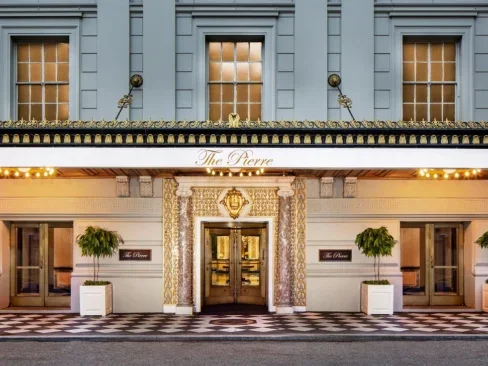
Prospective second-home buyers have long looked to the Bahamas as a starting point when searching for a winter base. Now, a new $85m penthouse at The Ocean Club, Four Seasons Residences, Bahamas is putting a price on how far the country’s luxury property market has stretched.
The residence is currently the most expensive home for sale in the Bahamas, a figure that puts it in different territory from existing luxury homes in the region. According to Knight Frank’s 2025/26 Bahamas luxury market report, trophy homes in Nassau typically reach around $40m, while beachfront properties on Harbour Island top out at approximately $15m. Private islands range from around $10m to more than $100m, depending on their location, infrastructure, and scale.

Even looking at previous listings and sales records, there is a sizable jump to get to the Ocean Club’s asking price. Zehava, the Thierry Despont-designed Harbour Island estate commissioned by former J.Crew CEO Mickey Drexler, came to market at $42m in 2024. Before that was Apsara, an eight-bedroom oceanfront estate in Old Fort Bay, which sold for $39.49m in April 2024 – the Ocean Club penthouse is asking more than twice that.
James Davies, partner at Knight Frank Caribbean and one of the authors of its Bahamas report, describes the $85m figure as “one of the biggest prices that we’ve seen” across the country. But he stops short of dismissing it as unrealistic. “The market in the Bahamas is in good health,” he says, pointing to demand from both vacation-home buyers and those relocating to the country. The Ocean Club also has another advantage, by “being attached to such an iconic development” like the Four Seasons and the reassurance that comes with a branded residence and its associated services. Plus, its famous cameo in James Bond Casino Royale hardly hurts.

Davies points out that while the figures cited in Knight Frank’s report reflect the wider market, buyers can already spend $50m to $80m on large, ocean-facing properties in developments such as Lyford Cay and Albany. The difference, he says, is that those homes do not come with “the power of having a brand attached to that” or “the full suite of services” offered by Four Seasons. For an internationally recognized five-star brand, that carries “a lot of weight.”
It helps explain why branded residences have become such a significant part of the Bahamas’ development pipeline. Nassau is seeing continued expansion at master-planned communities such as Albany and Old Fort, while Banyan Tree in Bimini, the Ritz-Carlton Reserve in Eleuthera, and Montage Cay in the Abacos are among the projects adding to the country’s growing roster of branded residences.

And while Knight Frank’s report describes overall market activity as having plateaued following the sharp post-pandemic upswing, at the very top end, “the demand doesn’t seem to be, as far as we’re concerned, slowing for the right offering,” according to Davies.
But there is a caveat. The branded-residence boom is not a licence to put a hotel name on any building and expect buyers to pay a premium. “You can’t just stick a building anywhere and slap a brand on it,” Davies says. The location, quality, offering, and brand all have to be right.

The Ocean Club, Four Seasons Residences is a collection of 67 private residences on Paradise Island, with the penthouse designed as a substantial family home rather than simply a pied-à-terre. The vision, says Winston Kong, partner at Champalimaud Design, was “to create a home that acted as a generational home, one that allowed for large gatherings/entertainment, while also allowing for intimate spaces of reprieve when needed.”
The property offers multiple living spaces, a family room, dens, en suite bedrooms and extensive terraces leading off from the bedrooms, all designed around the ocean views. The design team also considered configurations that could accommodate additional amenity spaces and junior primary suites for adult children. “We wanted the home to celebrate the views of the ocean and one that allowed for an indoor/outdoor lifestyle,” says Kong. He also acknowledges that the price of the penthouse created a particular design brief: “It certainly sets a level of expectation that needed to be reflected in the home.”

For prospective vacation-home buyers, the Bahamas has other advantages beyond its year-round weather and scenery. US buyers make up the largest share of its property market, while the country’s lack of income, capital gains, and inheritance taxes continues to attract international buyers. Economic permanent residency can also be obtained through a qualifying $1m investment.
None of this makes $85m a new normal for Bahamian property, and Davies is clear that it is a “big [and] bold” price. Whether the Ocean Club penthouse ultimately sells for anything close to that remains to be seen.