

Come fall, there are plenty of ways to guarantee avoiding the signature British weather.
There are Caribbean villas, private jets on standby and, failing that, a chauffeur waiting under the awning. But for those brief moments when even the most well-insulated life requires venturing onto London’s streets, there is always the reliable trench coat.
As predictable as the September rain itself, the pavements will soon experience their annual flood of beige gabardine and Nova check. Yet who can blame those city dwellers for reaching for the obvious solution?
There are few pieces of clothing you can identify as quickly as a Burberry trench – especially one that doesn’t require a gargantuan garish logo plastered all over it. See a belted waist, double-breasted front, epaulettes, and a check lining, and the odds are that you’re looking at Burberry.

But staying power in fashion is a funny thing. Trends are supposed to disappear; even the most successful pieces eventually find themselves consigned to the back of the closet. And yet after a century since its creation, the Burberry trench continues to be pulled out year after year (some could say like a seasonal life support machine for a brand that in recent times has found itself somewhat struggling).
And the reason why begins with the weather. Thomas Burberry invented cotton gabardine in 1879, creating a lightweight, hard-wearing fabric designed to protect its wearer from the elements. The trench that followed was built around that practicality, with details such as the storm flap, throat latch, and belt doing actual jobs.
Related article: What To Expect From Schiaparelli’s First UK Exhibition
That origin story is the starting point for The Burberry Trench: Crafting an Icon, a new display at London’s V&A opening today, September 21. Oriole Cullen, senior curator of fashion and textiles at the V&A, calls it “a British fashion staple that has stood the test of time and continues to evolve over a century on.”

It is a difficult claim to rebut when the garment has quite literally made it through more than 100 years. Hollywood did its bit early on to help with the Burberry trench’s popularity campaign: Humphrey Bogart wore one in Casablanca; Audrey Hepburn’s Breakfast at Tiffany‘s appearance gave it a certain sort of polished yet rain-soaked glamour. Then there’s Princess Diana, Kate Moss, and countless other models, musicians, and actors who have kept it circulating through the fashion system.
“The Burberry trench is a global design icon rooted in British craftsmanship and a symbol of innovation, creativity, and timeless style,” says Carly Eck, brand curator at Burberry. There is, naturally, a little branding baked into that sentence. “Icon”, after all, is not a neutral description when you’re selling the thing in question. But as the V&A exhibition explores, the trench does have one quality that makes a strong case for it: it can be repeatedly redesigned without becoming unrecognizable.

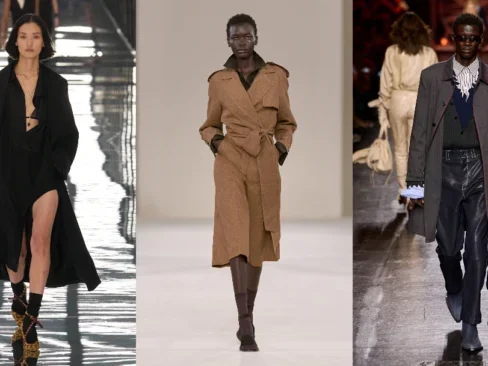
The exhibition’s final section brings together 19 runway looks from the past 25 years, including work by former and current creative directors Christopher Bailey and Daniel Lee. Proportions are stretched, details exaggerated, and familiar components pulled apart and put back together. The trench coat has a strong enough visual identity to survive fashion’s constant need to reinvent things, and Burberry has had more than a century to make sure we know what brand we’re looking at.
Related article: What Not to Miss at London Design Festival 2026
The V&A is leaning heavily into the notion of “Britishness,” too. The display occupies the museum’s rarely seen Prince Consort Gallery, beneath a ceiling inspired by John Constable’s painting of Hampstead Heath. Clouds overhead evoke rain, the most dependable of British accessories, and a reminder of the problem the trench was there to initially solve (before it was put into glass boxes at a museum).