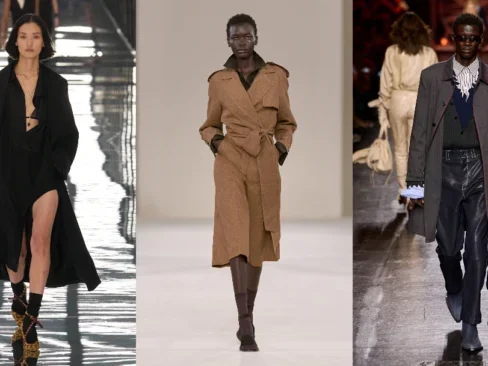


A Renaissance moment is stirring at London Fashion Week.
Across the city, key designers looked to the Old Masters for inspiration, while a broader sense emerged that the British runway season is enjoying a revival. Beneath it all was a Battle of Britain: an effort to restore the fortunes of UK fashion, still reeling from the impact of Brexit.
Despite the worldwide downturn in luxury consumption, this was a bumper season, with 47 shows staged over five days. The schedule was bolstered by the much-anticipated debut of Christopher Kane at Mulberry, and climaxed on Monday evening by a Celia Birtwell-inspired restoration Burberry show.
On what editors have come to call ‘Super Sunday’, Simone Rocha found inspiration in Caravaggio’s long-lost masterpiece The Taking of Christ, while at McQueen, creative director Seán McGirr drew on Piero della Francesca’s The Baptism of Christ at the National Gallery. It was an intriguing season in which London’s designers looked backward in order to move forward. Here’s the shows and designers that stood out.
Burberry: Celia Birtwell chic

After three tricky years, Burberry posted an encouraging first quarter, with a 5 percent rise in turnover to £455m (approx. $607m). It was the British group’s best quarterly performance in three years, as America-based chief executive Joshua Schulman refocused the house on its icons – the trench and the check. The night before the show, Schulman hosted the opening of The Burberry Trench: Crafting an Icon exhibition at the V&A.
The brand’s LFW show celebrated Burberry’s 170th anniversary with a special collaboration with Britain’s most famous fabric designer, Celia Birtwell. It was a diplomatic affair, too, with left-wing London mayor Sadiq Khan seated just one place away from Kemi Badenoch, leader of the right-wing Conservative Party.
“It’s pretty self-explanatory,” Daniel Lee, Burberry’s creative director, told Elite Traveler of his meeting with Birtwell back in May. He was, he said, “so inspired by her energy, her zest for life.
“Obviously, everybody loves Ozzie. Everybody loves Celia. Now she’s the epitome of British fashion,” added Lee when referring to Ozzie Clark, her husband and creative partner.

Staged inside the Chelsea College of Arts, the collection gave Birtwell’s revamped Burberry signature checks a more human touch. But at its heart were bold jacquard trenches, tops, windcheaters and blousons finished with runway embroideries, alongside beautiful, feminine, diaphanous dresses that would surely have made Ozzie proud.
Much of the collection was cut in silk taffeta, a fabric that married humility and simplicity with couture flourishes: crumpled pleats, washed-out surfaces, and delicate embroidery. The finale brought trench coats covered in mimosa-colored fabric flowers.
For Lee, the underlying idea was to imbue the clothes with emotion and create a luxury product with “emotional attachment.” It is a timely strategy. With global fashion houses under immense pressure, British labels are engaged in their own fashionable Battle of Britain, fighting to remain relevant in an increasingly competitive international market.
McQueen returns from Paris

Returning to the official London season after a 25-year absence, the McQueen show was a homecoming for this quintessentially British house, which first decamped to Paris under its founder, Alexander McQueen. A carnival of exotic creatures and characters populated the runway, staged beneath the Gothic arches of Lincoln’s Inn. Equally exotic was Emma Corrin, who arrived in a one-shoulder, semi-sheer gown, joining Emilia Clarke, Florence Welch, and fashion’s latest generation of nepo babies, Lila Moss and Georgia May Jagger, in the front row.
There was a Game of Thrones air about the hair, with towering two-foot-high silvery wax horns. The models epitomized “angels in the dark,” explained McGirr, who whipped up dense fabric flower cocktails and skirts topped by bat wing jackets or swirling nocturnal jacquard dresses. Elsewhere, lacquered satin columns were finished with metal embroidery and leather harnesses, and wicked gowns were topped with cock feathers.

It was a co-ed collection that also delivered some fantastic men’s suiting, drawing on the expertise of Savile Row’s Huntsman, the storied tailor with whom Alexander McQueen first launched a bespoke menswear collection back in 2002. The collection was powerful, albeit for a house going through troubled times, having reportedly cut 20 percent of its staff over the past year. If the rumors prove true that this is McGirr’s final collection for McQueen, he can leave with his head held high.
Simone Rocha: Caravaggio cool

Boasting over 200 major international boutique clients, Simone Rocha is contemporary British fashion’s most successful designer… even if she’s Irish-born. Earlier on Sunday, she faced scores of editors and critics inside the Old Bailey for a collection which again riffed on an Old Master: Caravaggio’s masterpiece which was famously rediscovered in a Dublin dining room in 1990, before being placed in the National Gallery of Ireland.
That inspiration led to a wonderfully romantic collection of cocoon dresses: voluptuous and voluminous gowns and parkas, finished with punky metallic embroideries, fabric flower, or technical gabardine rose-shaped necklines. These were juxtaposed by sexier micro-sequinned dresses, sturdy green parkas, and two perfectly cut sapphire velvet cocktail dresses, in what Simone defined as a “Caravaggio blue” shade.
Erdem: From Bloomsbury to Barbette

Erdem’s LFW show was a bold change of inspiration for the Turkish-Canadian designer Erdem Moralıoğlu, away from his traditional obsession with the literary icons of Bloomsbury to a transexual trapeze artist, Barbette (a legendary icon in Paris). Originally a Texan man, Barbette became a brilliant high-wire performer, who at curtain call would reveal his masculinity by pulling off his wig.
A muse to French poet and playwright Jean Cocteau, and frequently photographed by Man Ray, Barbette ignited a collection of glittering looks at Erdem. These included trapeze leotards and galvanized micro smoking jackets worn with Edwardian dress shirts over shorts, to Ringmaster tailcoats with crystal embellishment and floral bedecked metallic tulle dresses, all the way to slip dresses.

The collection also included wonderful forest green utility coats with highway man shoulders; precious yet saucy tutus; and crushed silk pattern dresses that evoked an acrobat in mid-air. The show was staged in the temple of Rock ‘N Roll, the Roundhouse in Camden.
Mulberry by Christopher Kane: Retro modern

One of Britain’s greatest brands, Mulberry, returned to the runway with a precise and polished display of retro utilitarian chic by new creative director Christopher Kane. The collection concentrated on refreshing the house’s codes, most notably its iconic Bayswater bag (whose crenellated flaps became the signifier of a series of sleek ergonomic leather separates, trenches, mini dresses, and clinker-built cocktail dresses) in muted hues of cement, white, beige, and eggshell.
His few exceptions were tight, bright orange or purple parka dresses with bizarre funnel necks which entirely hid the models’ faces, to heritage check raincoats and several feather-light, gauzy cocktail dresses. Add in a fresh take on classic bags, and this suddenly made Mulberry become what it has not been in ages: relevant. “I wanted a past that is present, not as nostalgia, but as something active, useful, and alive,” underlined Kane, who won the most deafening applause of the season.
Di Petsa’s fertility fashion

Ancient Earth mothers and sultry goddesses vied for attention at Di Petsa’s latest show, a collection that celebrated several firsts. Models slipped between a cast of mythological personalities: doting mothers in Grecian goddess gowns, cradling infants in their arms; latter-day Telemachuses eloping with their mothers, Penelopes – he in a fencing shirt and loincloth, she in a deep-gorge halterneck overall. Both, it seemed, had already decided that Ulysses was not making it home from Troy.

Then came a heavily pregnant, gloriously bosomed Diameter (played by Little Mix singer Leigh-Anne Pinnock), who led out six sirens before spraying them all from her mammary glands. The collection was largely rendered in transparent, body-conscious chiffons, accessorized with golden chains, bicep bracelets, and nipple rings – a reminder that London will always have a soft spot for eccentricity.
London Fashion Week standout designers
London Fashion Week is the greatest fashion training ground on the planet. It may have only one truly global brand, Burberry, but it also boasts fashion’s greatest colleges. And, as a result, the most dynamic young talent in the world. Fairly obscure young hopefuls can, in the space of a half-decade, end up running superstar labels in Milan and Paris. Four happening new creatives really stood out.
Paolo Carzana: Quirky crusade chic

Loosely inspired by Indiana Jones’ The Last Crusade, the latest Paolo Carzana collection was staged inside St Cuthberts Church made into a calico box on which the model silhouettes were projected dramatically. Composed in washed out hemp or sundried cottons, the result was pleated and collage, faintly medieval fantasy eveningwear that was frequently beautiful. In terms of raw talent, Carzana is the most compelling new name in the UK.
Aaron Esch: Rebellion in the Electric Ballroom

There were romantic Rock ‘N Roll rebel designs at Aaron Esch, such as hooded leather bike jackets cut remarkably like blouses. Unveiled Saturday in the famed rock temple of the Electric Ballroom in Camden, one wizened editor commented: “I think this is the first time any of us have been here sober before midnight in our lives.”
Styled by fashion legend Katy England, with sounds by her son Lux Gillespie, this show was an electric display. The most notable standouts were the menswear: pink, silk double-breasted blazers and pencil pants. In a word, someone should let Esch lose on a Milan marque.
Johanna Parv: Active sports, aced

One day a giant active sports brand will make Johanna Parv their global creative director. The sooner the better. Her presentation had clothes suspended, almost in action in the air. From bent-knee denim cycling shorts and techy architectural pants to microfiber sporty waistcoats and all manner of hi-tech harnesses.
The collection was shown in front of a series of mini video vignettes filmed around London. This was a high-impact display on a tiny budget by an Estonian star designer destined for great things.
Pauline Dujancourt: Gallic couture in Blighty

Pauline Dujancourt, the Frenchwoman who has made London her home, staged a sensuously provocative and thoroughly chic show at LFW. Lovingly inspired by Rainer Werner Fassbinder’s 1972 opus The Bitter Tears of Petra von Kant, the collection was an intoxicating assemblage of alpaca-loomed flowers, spidery crochet, tweed jacquard and ribbons – a brilliant evocation of diaphanous devilry.
Now supported by Sir Paul Smith’s foundation for young designers, Dujancourt has moved beyond the entirely handmade approach of previous seasons into professional manufacturing, giving her clothes a newfound polish without sacrificing their sense of intimacy and craft.
In a word, Dujancourt looks like an ideal candidate for a forward-thinking Paris couture house in search of a new creative broom.
John Richmond: Backstage pass dressing

For those readers boasting a backstage pass to a major stadium concert, John Richmond remains the designer of choice. For men, the collection offered perforated lace pattern lambskin jackets, silver leather blousons, and chain-wrapped rock god boots.
For women, slinky bejeweled columns slashed just below the crotch, turquoise satin tuxedos, and taut guipure lace tops. The show took place in the crypt underneath St Martin’s in the Fields, and was a reminder that when it comes to punchy eccentricity, no fashion capital will ever match London. Now, onward to Milan.