There’s bucketloads of architectural heritage, a thriving financial district, mindblowing art (The Last Supper by Leonardo da Vinci calls the city home) and a world-leading fashion scene. And to top it all off? Milan has some of Italy’s best restaurants, too.
Classic Milanese dishes are hearty and rich, with a focus on meat-heavy delicacies, such as Risotto alla Milanese, a meaty risotto infused with saffron; ossobuco, a heavy veal stew; and a breaded veal cutlet called cotoletta. As is typical across Italy, you'll find plenty of small, typically family-run trattorias serving up
However, with a total of 23 Michelin-starred restaurants, Milan's fine dining scene is a thriving beast, too. The city's finest chefs deftly showcase their skills, highlighting both classic Italian cuisine and international influences. These are seven of the best restaurants in Milan. Be warned: reservations disappear quickly.
The best restaurants in Milan
-

Il Luogo di Aimo e Nadia
Despite its slick contemporary look, Michelin-starred Il Luogo di Aimo e Nadia actually has plenty of history under its belt and first opened in 1962. The restaurant is now led by chefs Alessandro Negrini and Fabio Pisani and offers three options: a la carte or two tasting menus – the more traditional Percorsi menu and the experimental Territori offering. Sommelier Alberto Piras is on hand to make some excellent wine recommendations, too.
-
Giacomo
Swanky yet understated, Giacomo has successfully positioned itself as a restaurant beloved by locals, flashy tourists, and A-List celebs alike. Located on an anonymous residential street just 15 minutes from the historical city center, the restaurant retains its sense of in-the-know secret, despite being regarded as one of the best restaurants in Milan. (there’s a flashier outpost of Giacomo with Duomo views, too).
If you’re not looking out for celebrities, the decor is something to be marveled at: celadon-colored walls, bookshelves, and a striking mosaic floor. The menu focuses on fresh seafood prepared with wonderful Italian simplicity and sophisticated pasta dishes.b
-

Cracco
Located inside the iconic Galleria Vittorio Emanuele II, Michelin-starred Cracco is a restaurant in which to see and be seen. The interiors are a wonder and deftly forgo the more modern style that many Milanese restaurants prefer in favor of maximalist, Baroque-style beauty. There’s gilded edges, ornate panelling, and mirrored walls; dimmed lighting further adds to the ambiance.
Don’t be fooled into its all style and no substance, though. Chef Carlo Cracco’s vision, executed by head chef Luca Sacchi, celebrates Milanese culinary traditions while adding a creative flair. For example, there’s the classic Milanese veal, but also a rich chocolate souffle with lard and chilli. Diners can go a la carte or opt for the tasting menu.
Wine is a big focus, too. Curated by sommelier Gianluca Sanso, Cracco’s cellar is over 10,000-bottle strong and, unlike many Milanese restaurants, showcases plenty of French labels alongside Italian.
-

Sadler
Venture inside Casa Baglioni, a hotel set within an Art Nouveau building dating to 1913, and you will find the Michelin-starred Sadler – a petite restaurant with a contemporary edge.
While Italian traditions guide the menu, chef Claudio Sadler’s cuisine takes on international influence too. From the British classic of fish and chips to Asian-inspired wasabi mayonnaise, Sadler covers all bases.
The dining room itself is elegant yet modern, much like the hotel it sits in. Don’t miss a trip to the rooftop bar for pre- or post-dinner drinks – the views across Milan are spectacular.
-
Enrico Bartolini al Mudec
The only place in the city to sport the maximum of three Michelin stars (according to the 2026 guide) and one of just 14 in the whole of Italy, Enrico Bartolini al Mudec rightly takes its place as one of Milan’s very best restaurants.
Situated on the third floor of the Museum of Cultures, chef Enrico Bartolini has built his philosophy around its location, with a firm focus on culinary culture. The restaurant offers two tasting menus: ‘Best Of,’ which showcases Bartolini’s best-known dishes and the ‘Mudec Experience,’ which is more experiential.
-

Andrea Aprea
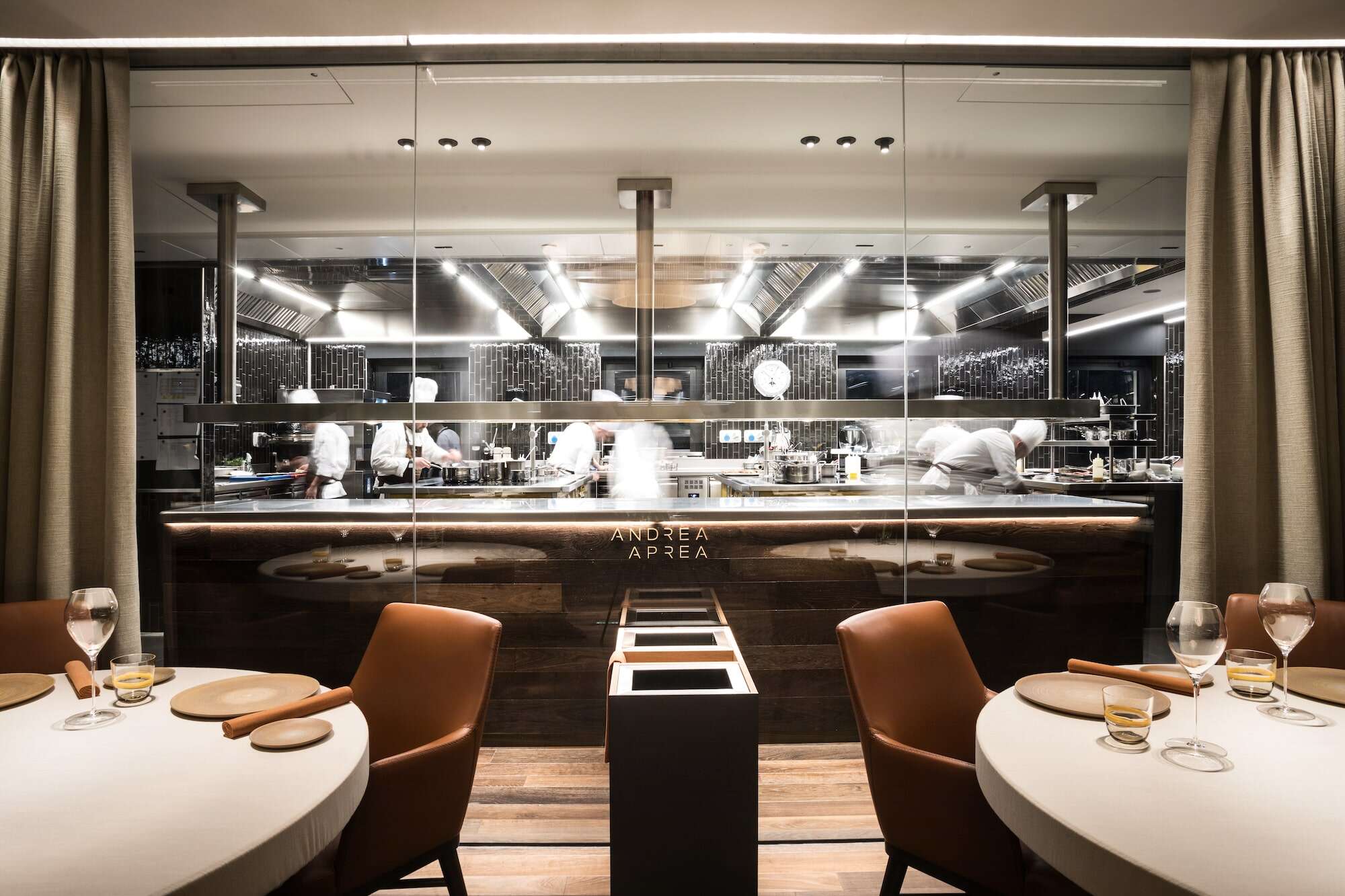
Andrea Aprea Restaurant is the second location in Milan from its eponymous chef. Expectations were high but Aprea delivered – the restaurant was awarded its first Michelin star in mere months, with a second awarded in the 2024 guide.
In addition to one-off special occasion menus, the restaurant runs three permanent set menus: Contemporaneità is about memory; Partenope examines a particular region of Italy; and finally, the star of the show, Signature – an eight-course menu rooted in Aprea’s culinary philosophies.
Located on the top floor of the Art Museum of Luigi Rovati Foundation, Andrea Aprea Restaurant is just as much about the setting as it is the food, with an atmospheric contemporary dining room overlooking both Porta Venezia Park and the busy open kitchen.
-

Ristorante D'O
Admittedly, if you’re only in Milan for a night or two, Ristorante D’O won’t be top of your list. But, if you’ve got time to spare, a short pilgrimage out of the city will be well worth your efforts.
The only Green-Michelin-starred restaurant in the area (and with two ‘standard’ stars to boot) D’O is the brainchild of chef Davide Oldani who keeps one eye on the past and another in the future in his culinary style. Italian traditions are firmly upheld, but his focus on sustainability means forward-thinking ideas and techniques are vital. He even has his own workshop for creating in-house flours and yeast products.
The food itself (which Oldani describes as ‘pop’ cuisine) is often deceptively simple. Expect detail-driven dishes with a focus on beautiful plating.st