


New York is one of the busiest aviation markets in the US – more than 3,000 commercial flights pass through the city’s airports on a normal day.
That means the airspace can get pretty crowded, with up to 270 flight operations per hour. Flying into the city, even privately, can come with its share of congestion and complications.
The good news is that private aviation airports are scattered across the metropolitan area, many offering easy access to Manhattan while others make more sense if you’re heading to another destination. Where you land can have a surprisingly big impact on how quickly you reach the city. Here are the airports worth knowing.
Private jet terminals in New York
-

Teterboro Airport
 Teterboro, New Jersey
This isn’t in New York itself, but it’s close to Midtown Manhattan (around 12 miles or a half-hour drive) and is the busiest private jet terminal in the world. It records tens of thousands of business jet departures every year – which is nearly double the traffic of its nearest competitors. It’s the airport of choice for Wall Street execs, finance leaders, and high-profile travelers who are visiting the city.
There are multiple FBOS and terminals at Teterboro, including Signature Aviation, Atlantic Aviation, and Jet Aviation. Signature operates multiple facilities including the main terminal and Signature TEB West, providing fuel, hangars, de-icing, and lounges. Atlantic offers 24/7 ground handling, heated hangar space for larger jets, and international trash handling. Jet Aviation provides lounges, conference rooms, and pilot snooze rooms.
Tereboro is also home to the Aviation Hall of Fame New Jersey – it’s located on the airport grounds and features historic aircraft artifacts and a research library.
Distance from Manhattan: 12 miles
Runway: 7,000 ft
-

Westchester County Airport
West Harrison, NY A calmer option for when Teterboro gets too busy, Westchester County Airport connects travelers to northern suburbs, Connecticut, or the Hudson Valley. The FBOS on-site include Million Air White Plains which is often ranked as one of the best in the country with a rustic stone fireplace lounge, indoor golf simulator, and a fleet of Mercedes-Benz crew cars. Signature Aviation has an enormous 24-hour facility and is known for its privacy policies (tarmac vehicle pull-ups) and rapid refueling turns.
There are two main runways; one stretches 6,549 ft which can accommodate super-midzie jets and large long-range jets like the Gulfstream G650 or the Bombardier Global 7500.
The airport is currently undergoing its most significant infrastructure transformation in decades – an $18m FAA grant means the 60-year-old control tower will be entirely replaced, and there will be a $150m terminal redesign. Crucially, the airport’s historic 240-passenger-per-half-hour cap means the airport will not increase its flight capacity and will remain the quieter option.
Distance from Manhattan: 33 miles north
Runway: 6,549 ft
Related article: The Best Hotels in New York and the Best Suites to Book
-
Republic Airport
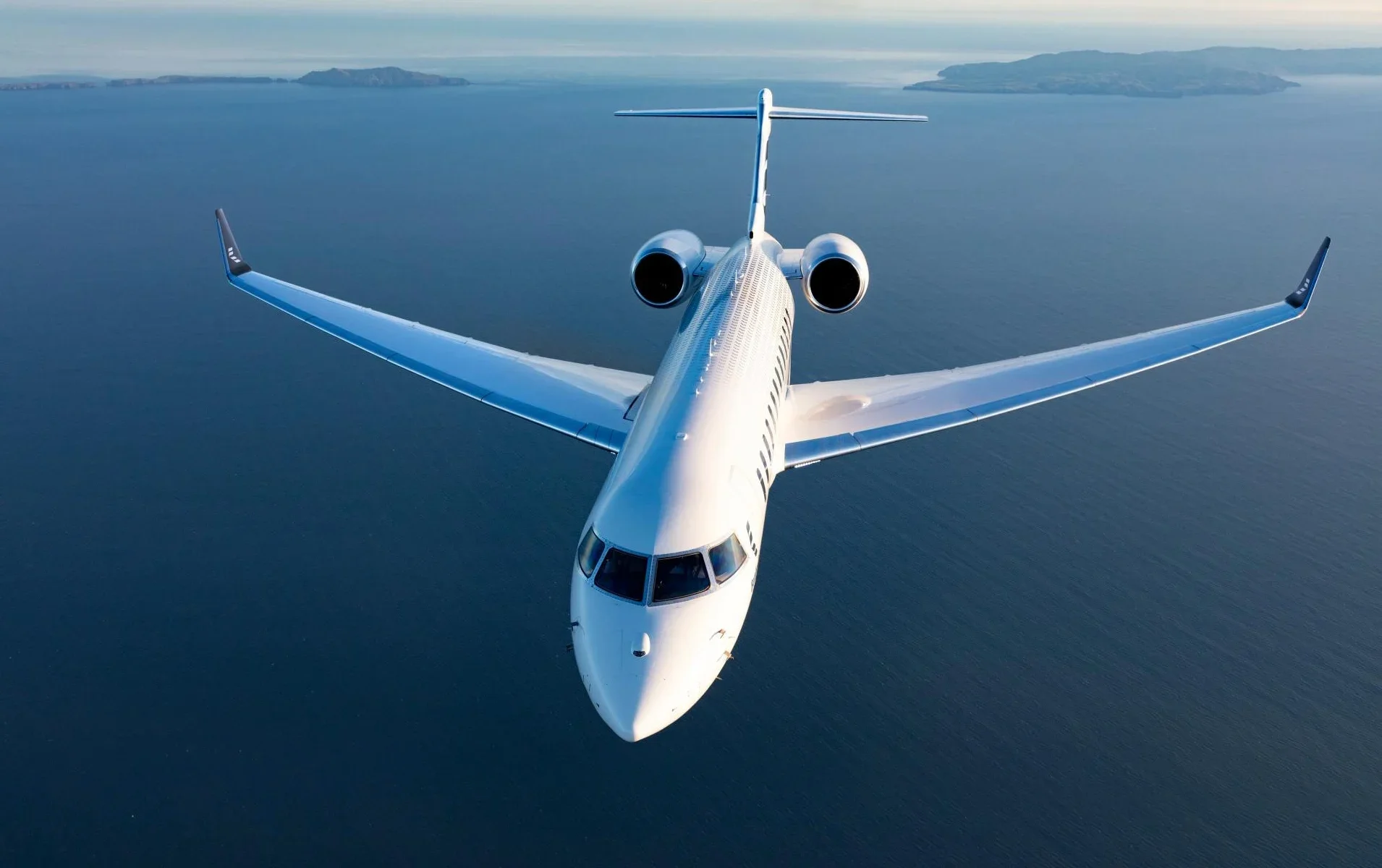
Farmingdale, NY Republic Airport has two runways; one of which is the 6,827-ft main runway that can handle super-midsize jets (like the Gulfstream G650 or Bombardier Global 7500, pictured) comfortably, as well as light- and mid-size jets. The runways are perpendicular to one another which allows for good runway access even with unpredictable weather.
Its position makes it a gateway to the Hamptons, Long Island, and eastern coastal towns, but it wasn’t always a private jet playground. It has a big American military aircraft manufacturing history; during WWII, more than 9,000 P-47 Thunderbolts were produced here, and the F-84 Thunderjet and F-105 Thunderchief were produced here, too. The airport is home to the American Air Power Museum so you can see historic military aircraft including those from WWII.
Distance to Manhattan: 40 miles east
Runway: 6,827 ft
-

Long Island MacArthur Airport
Ronkonkoma, NY Located in the Town of Islip in Suffolk County, Long Island MacArthur Airport (or ISP as it’s more commonly known) is the closest and most convenient for Long Islanders. It serves both private and commercial planes, and is a calmer alternative to some of New York’s busier hubs and avoids the air traffic of the central locations.
Covering over 1,300 acres, it has three runways (the largest of which is some 7,000-ft long and 150-ft wide) and two heli-pads. The airport is also home to five prominent flight schools; some for professional pilot training and others for learning to fly for fun, as well as helicopter flight training.
Distance to Manhattan: 54 miles east
Runway: 7,000 ft
Related article: The Best Fine-Dining Restaurants in New York
-

Stewart International Airport
New Windsor, NY A solid choice for those heading to New York, the Hudson Valley, and northern New Jersey, Stewart International Airport in New Windsor still can get you to Manhattan in around an hour-and-a-half’s drive. Its runway – at 12,000 ft – can handle all jet sizes, including ultra-long range, like the Gulfstream G800 for those traveling long-haul. There are two FBOs, Signature Aviation and Atlantic Aviation, as well as a 24-hour air-traffic control.
It was initially built in the 1930s as a training field for cadets at nearby West Point, and continues to host the 105th Airlift Wing of the New York Air National Guard and Marine Aerial Refueler Transport Squadron 452. It was also previously designated as an emergency landing site for NASA’s space shuttle.
Distance to Manhattan: 60 miles north
Runway: 12,000 ft
-

Morristown Municipal Airport
New Jersey In Morris County, New Jersey, Morristown Airport has a 6,000-ft runway and two FBOs, Signature Aviation and Atlantic Aviation. There are US Customs and Border Protection facilities for any international arrivals, plus hangar and tie-down space.
In the 1930s, the airport was pegged as a potential US base for the German Zeppelin Company. The Hindenburg flew over the site in 1936, but a crash at Lakehurst put a firm stop to those plans. The airport was developed during World War II; it was used to train army and navy pilots. In the 1960s, it developed into a private aviation hub and earned the nickname of “The VIP Stop” due to the increasing number of jets touching down.
Distance to Manhattan: 40 miles west
Runway: 6,000 ft