
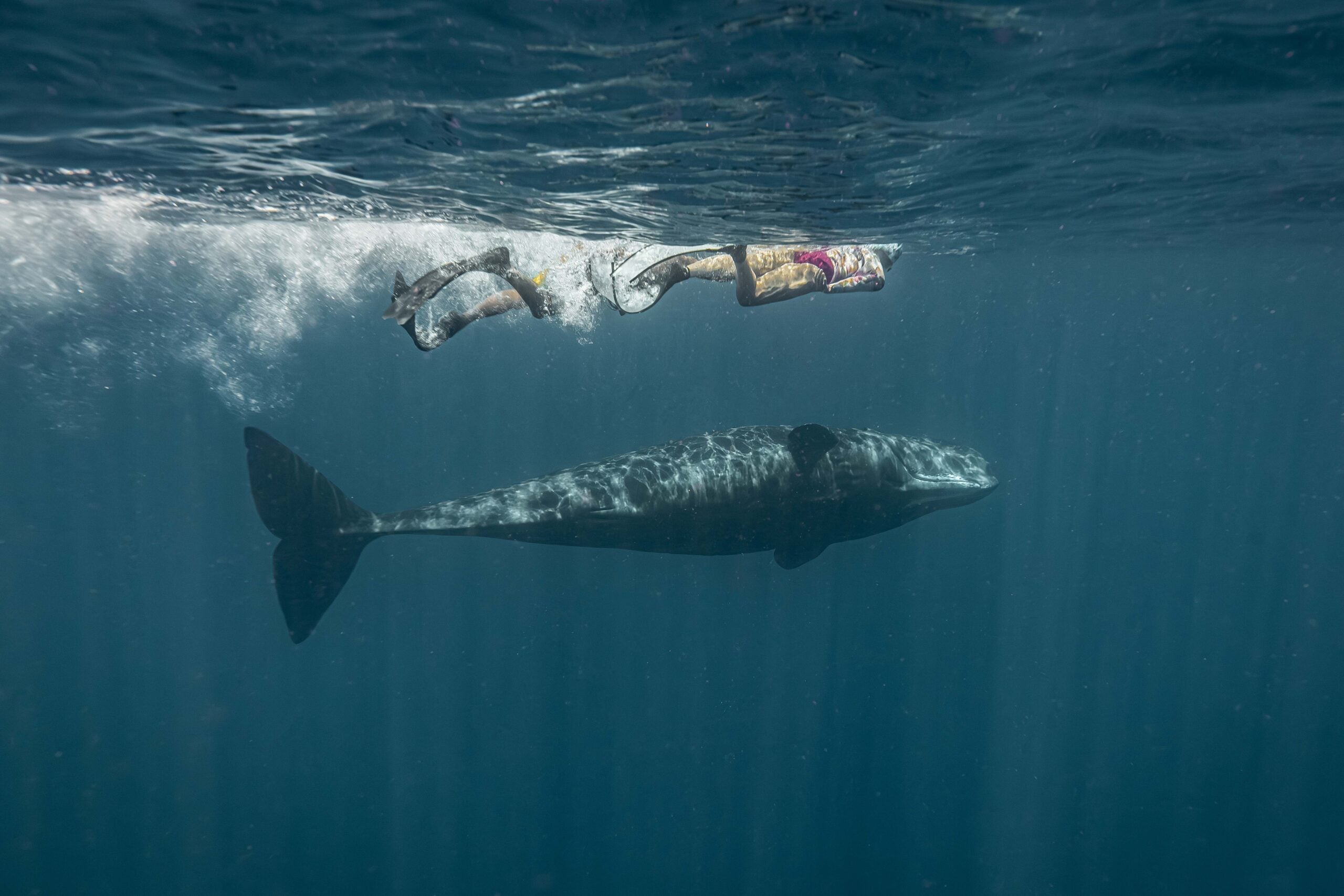
A flick of the fluke and it’s gone. Suspended in cobalt blue, with no immediate points of reference, I feel deliriously lost. Only moments before, the water around me had been filled by a creature so enormous, it swallowed my entire field of vision.
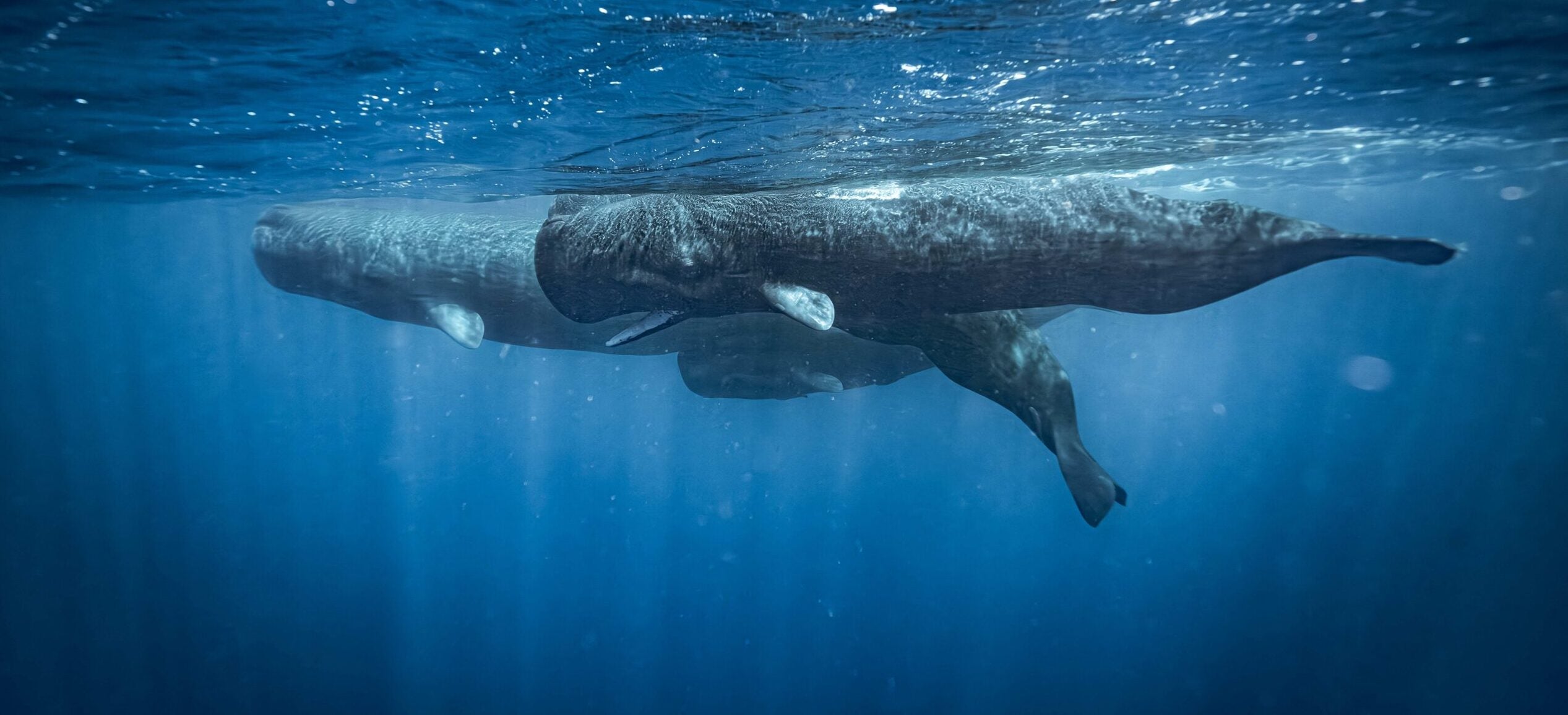
I could make out every intricate detail. Below a halo of golden light at the surface, its skin was like brushed gunmetal. Folds rippled like a mountain range and jagged scars bore testament to a life spent fighting for survival. But there was nothing belligerent about the 45-ton torpedo that drifted weightlessly through the ocean. Far greater than its body mass, the whale had an intangible aura, reducing me to a tiny speck. Our shared gaze had forged a momentary connection, like a green flash right before the sun disappears. Now, vanishing into a gloomy void, the sperm whale I’d been following became nothing more than a mirage, entering a realm no human body – let alone mind – could possibly fathom.
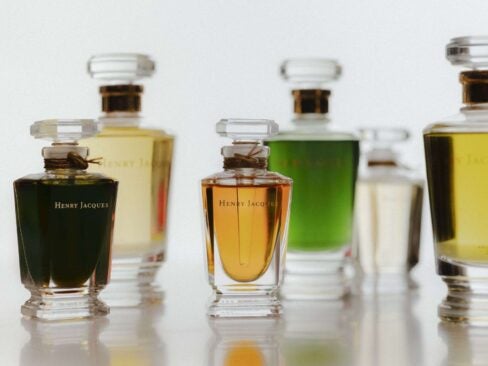
Mystery has always surrounded these deep-diving specialists, which are capable of plummeting 5,000 ft to hunt giant squid. American author Herman Melville cast the creature as a terrifyingly intelligent leviathan in his classic 19th-century novel Moby Dick, while biblical prophet Jonah found a refuge for repentance in its belly. Even the perfume industry holds the enigmatic cetacean in high esteem. Rare and pricey ambergris, an intestinal secretion produced by only one percent of sperm whales and expelled through their rectum, was once a curious yet core ingredient of Chanel No 5.
Wild fantasies translate into even wilder realities. Caribbean island Dominica is one of only two places in the world where it’s possible for tourists to legally swim with sperm whales. (The alternative but less reliable option is Sri Lanka.) A narrow coastal shelf with a deep drop-off close to shore makes it easier to reach the resident population of 200 mothers seeking a safe feeding ground in which to nurse and train their calves.
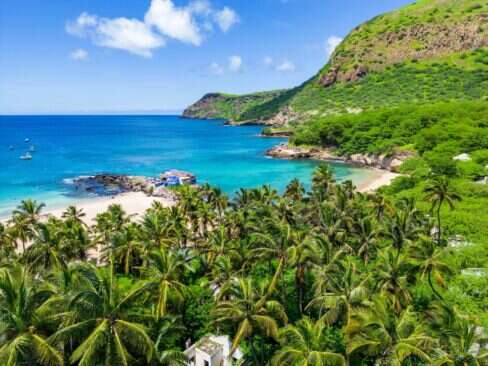
Aptly nicknamed ‘nature island,’ the region’s most recently formed landmass soars to 4,747 ft above sea level, but its heavenly, spell-binding topography is shaped by the underworld. Dense, glossy rainforest envelops nine active volcanoes, multiple sulphurspewing valleys, and a flooded volcanic crater, known as the Boiling Lake, which bubbles with the ferocity of a witch’s cauldron.
Approximately 66,000 residents live in clusters of cheerfully painted houses woven together by winding, pot-holed roads. In stark contrast to popular vacation destinations like Barbados and Antigua, less than a quarter of the island has been developed. The same mountainous terrain that caused headaches for British colonialists centuries ago has kept the usual resort giants at bay.
That could all soon change. Major investments – including a cable car to the Boiling Lake and a $200m marina project – are expected to attract more tourists arriving either by cruise ship or on long-haul flights landing at the island’s first large-scale international airport, slated to be operational by the end of 2027.
In a country where – aside from a 1990s boom in ‘green gold’ banana exports – the economy is as sluggish as beachgoers in the midday sun and the average annual wage is $9,000, development is needed. Striking a careful balance between productivity and preservation is the biggest challenge.
Jackson Mawhinney, who co-runs boutique eco-tourism company Diving with Giants, believes the solution lies in focusing on high-end tourism. “The new version of luxury is remoteness,” he says, as we charge through frothing whitecaps searching for whales. “What once held Dominica back could catapult it forward if we progress in a responsible way.”
The son of Baroness Patricia Scotland, a British politician and former Deputy High Court judge who left Dominica aged two as part of the Windrush mass migration, Mawhinney divides his time between the jungle and London’s Mayfair. He’s one of several second-generation entrepreneurs who are eager to give something back to their homeland.
Only a handful of companies have been granted permits to dive with sperm whales, and Diving with Giants is one of them. Mawhinney launched the business with photographer and free diver Adam Slama after the pair met at a Soho House gym in West London. As part of a partnership with adventure planners Eyos Expeditions, they operate sea-based tours on the newly refitted superyacht Solace.
See also: An Expert Guide to Yacht Shows Around the World
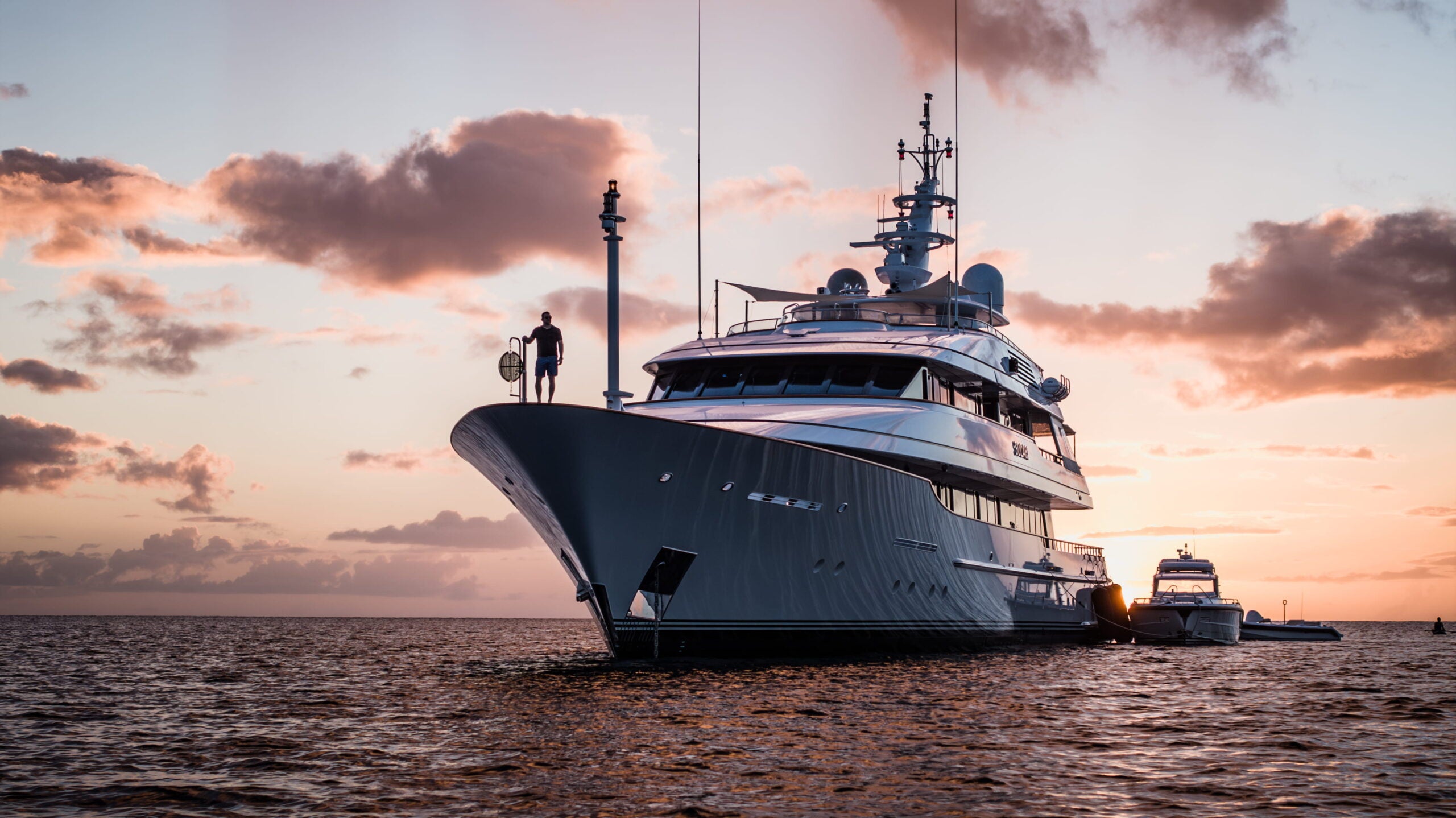
I’d joined the 187-ft vessel 24 hours earlier, boarding in Antigua’s English Harbour and sailing overnight. At dawn, sleepy Dominica snuggled beneath a blanket of clouds. Pools of sunlight exposed her contours and curves, revealing a timeless beauty below ever-shifting skies.
Aside from a brief sighting, our first morning of whalewatching had been unsuccessful. After snorkeling through effervescent geothermal vents at the appropriately named Champagne Bay, we’d returned to our floating five-star home. January is peak mating season, lasting from November to April. The arrival of several big males had likely sent the resident females into flux. Mawhinney was confident we’d find more whales in the morning.
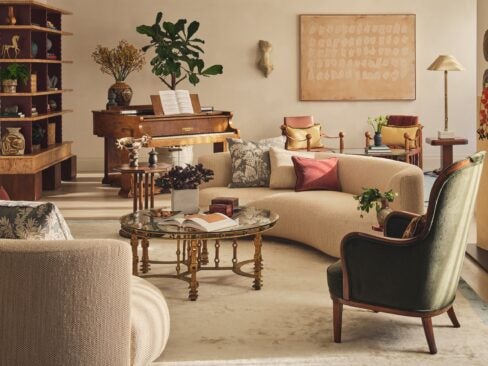
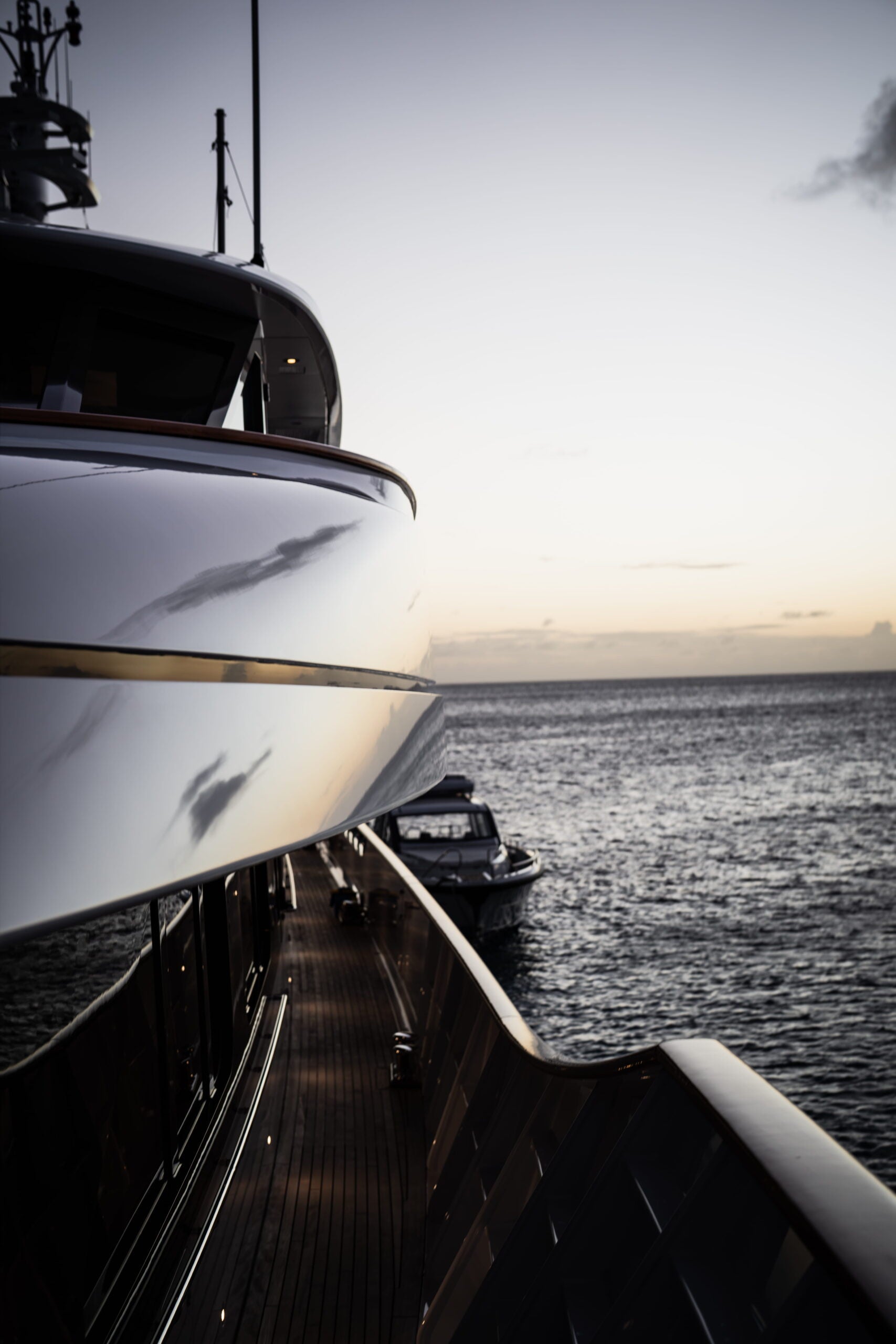
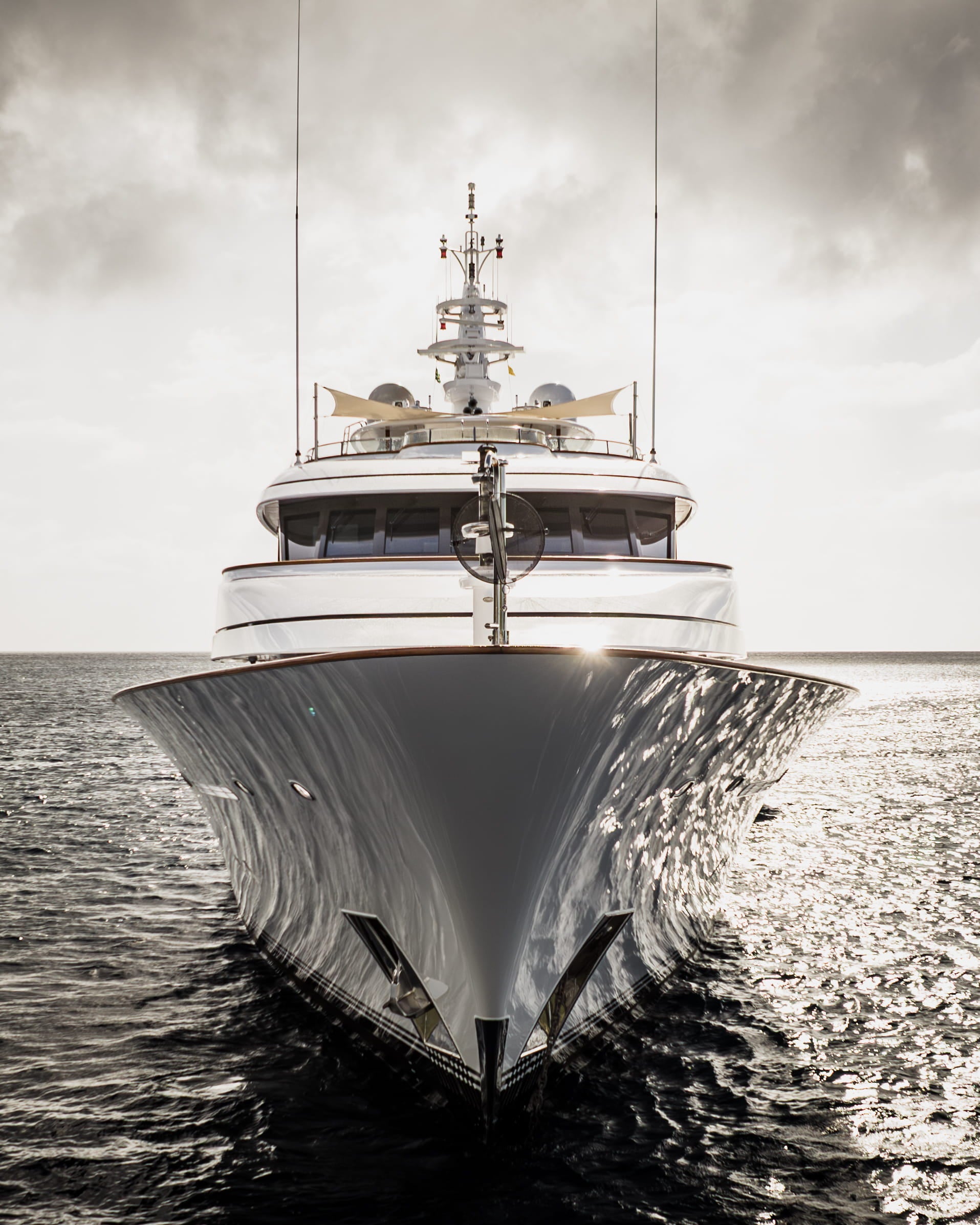
In the meantime, Solace wasn’t a bad place to hang out. Originally built in 2005, she completed a 10-month refit at the end of last year. Dressed in calming, understated interiors by British-based Vickers Studio, the sleek five-suite vessel reflects the aesthetics of its Scandinavian owner. A fine art photographer with an eye for form, his monochrome image of shadowy sand dunes hangs in the dining room. Elsewhere, artworks range from abstract cubist prints to pop-culture portraits by Yoshitomo Nara.
A sauna and hot tub promise relaxation, while high-energy fun comes in the form of seabobs, jetboards, and SUPs. The owner, who prefers to remain anonymous, wanted a vessel where memories could be made with his young family. In the lounge area, a handcrafted spinning globe by Bellerby & Co pinpoints Solace’s shipyard in Falmouth, England, and hints at the many explorations that lie ahead.
What sets it apart from other yachts is the spirit of expedition. Under the management of Eyos, the vessel will follow a three-year itinerary to remote locations around the world during which it will be available for private charter. Independent slots can be booked separately or connected to build a deeper narrative. Solace will return to Dominica in late November."
It’s a more holistic product than anything you’d typically find on yachts,” muses Eyos CEO Ben Lyons, who has joined us for the voyage, emphasizing the benefits of having a consistent crew and familiar faces to welcome back guests. “We bring the expedition element, but a lot hinges on the relationship with a captain. On a larger traditional expedition ship there are often too many egos and a hierarchy. We offer a tighter team, and that’s an integral part of the experience.”
Demonstrating a deeper commitment to the ocean beyond tourism, Eyos co-manages Yachts for Science, a not-for-profit organization that focuses on finding meaningful purpose for vessels that often lie idle for much of the year. “We basically play Tinder between the owners and scientists,” says Lyons. Solace has already agreed to facilitate a humpback whale survey in the Dominican Republic, pro bono.
Conversations with researchers and conservation experts also form part of the program for charter guests. Later that evening, Nawana Shillingford, the assistant maritime administrator for Dominica’s Ministry of Tourism, joins us for dinner. The young, unconventional government official played a role in establishing the world’s first Sperm Whale Reserve. Following a bill passed by parliament in October 2025, the pioneering initiative was officially inaugurated at the beginning of this year.
The law states that only permitted tourist vessels and artisanal fishing boats can pass through an area stretching for almost 304 square miles. Several sanctuaries within the reserve will have no activity at all.
“We love our sea-tizens,” she enthuses, pausing to emphasize her pun. “They’re our sisters, mothers, aunts. We affectionately name them after utensils like ‘spoon,’ ‘tin opener,’ and ‘fork.’” As essential to daily life as a piece of cutlery, the marine mammals are highly valued for their ability to sequester carbon in the deep sea and mitigate global warming. “You can’t put a price on them,” insists Shillingford, describing her own close-up experience with the whales as “amazing, astonishing, heartwarming, ethereal.”
Although some rules around the issuing of permits remain confusingly oblique, she insists that protection of nature far outweighs financial gain. Dominica, she points out, is “not the club that’s open for everyone.” Heading out on the water at 7am the following morning as tropical rain-showers blur any boundary between sky and sea, I feel privileged to be one of the chosen few.
My thoughts float back to my last encounter. Initially unnerved by churning waves, I’d found calm below the surface; any fears and reservations had been swept away by the current. Underwater, physical distances are deceptively difficult to determine. Every sight, sound, and movement is amplified.
See also: What It’s Like On Board the Orient Express Corinthian, The ‘World’s Largest Sailing Yacht’
Contracted by Diving with Giants, local boatman Gabriel Armour belongs to a family line of whale-watchers. Once we’ve identified several distinctive diagonal left-leaning blows on the horizon, he lowers a homemade hydrophone into the water. Crafted from a salad bowl covered in neoprene and gaffer-taped to a stick, it proves to be surprisingly effective, detecting a series of clicks.
“Listen,” he beckons, handing me a set of headphones to hear the rhythmic, coded conversations. The indecipherable message is our invitation to dive in.
Following Armour, I swim through choppy waves, struggling not to let water choke my snorkel. When the outline of a sperm whale finally comes into view, everything slows down. Gliding close to the surface with the streamlined buoyancy of a giant balloon, the animal’s gentle pace brings conventional time to a standstill. A wall of whale lies before me, stretching almost as far as I can see. For several minutes, I swim along the length of its body, until I find myself staring directly into that pebble-sized eye — a tiny window into a mighty soul. In the vast ocean, there is an acceptance of shared space, an intimate exchange in a distant realm.
True to Mawhinney’s promise, the whales have returned. On a subsequent dive, I witness two juveniles playfully twisting and turning before spiraling ever deeper. With a little more time, Armour claims we could have found a few of them taking a vertically suspended powernap.
Reflecting on my experience, it’s hard not to anthropomorphize the whales’ behavior. They do, after all, have the largest brain in the animal kingdom – weighing up to 20 lbs – and even develop wrinkles with age. Local marine biologists have no doubts about the complexities of their emotional intelligence. For the past six years, our guide has been working for non-profit organization Project CETI (Cetacean Translation Initiative) to crack the vocal codes used by different clans, and has known certain whales longer than his own children. Describing these family-specific forms of communication as a “dictionary of rhythms” expressed through varying dialects, he shares details of his discoveries over dinner.
Sperm whales in the Caribbean have small ranges, making it easier to study individual families over time. Unique to the region, they repeatedly return to the same islands, making their movements more predictable. Commenting on the playful behavior of the animals that morning, our guide concludes that they were probably “sexually excited and charged up.”
“I once worked with someone who described sperm whale activity as immense boredom separated by moments of insanity,” he adds. “In a normal day, you have one, maybe two, whales lying together, not making any sound. That repeats over and over again, and then something amazing happens.”
With the help of AI, he’s confident that scientists will soon be able to understand what sperm whales are saying. CETI is currently collecting around four billion whale vocalizations and behaviors to feed into a large language model similar to those that power systems like ChatGPT. They’ve already published a study showing that whales use vowels in a similar way to humans and could have a sophisticated language system that predates our own by millions of years. “I find it really hard to believe that a brain that is structured like ours, that has all of the special cells that ours have, can’t function in a similar way,” he tells us.
Getting too close to the animals – both physically and psychologically – does pose potential dangers. Over the past 20 years, locals have observed the mammals moving further offshore. Our guide believes port development, the introduction of high-speed ferries, and an increase in whale-watching tourism are inevitably having an impact. The biggest challenge is finding a model that benefits everyone, including the whales.
What happens on land ultimately shapes life at sea. Eager to show off his island, Mawhinney takes us ashore the next day. “My worst nightmare would be for Dominica to have a motorway like Barbados,” he declares, as we bump along a muddy track winding around the island’s tallest mountain, Morne Diablotins. Along the way, we pass thatched shacks stocked with glass bottles of homemade rum. The sweet smell of weed – which was recently decriminalized for personal use – wafts from porchways, where residents rock on wooden chairs behind a dreamy haze of smoke.
Splashing through one of the island’s 365 rivers, we make our way to Syndicate Falls for a traditional cleansing ceremony led by a shaman from the Kalinago people – the only truly indigenous community in the Caribbean. Wearing a fringed suede waistcoat, feathered headdress, and an animal-bone necklace, the shaman prepares a mixture of herbs to wash over our bodies. Afterward, we are invited to soak in cool waters tumbling from a single-drop cascade (a waterfall that descends in one uninterrupted fall rather than in steps) as red-necked parrots flit through the treetops.
From providing the ingredients used in herbal medicines to putting food on the table, the natural world plays a pivotal role in supporting the lives of Dominicans. But it’s capable of wreaking havoc, too. In September 2017, Hurricane Maria devastated the island. “You see all that green?” gestures Mawhinney, pointing to the forest around us. “Everything was brown. Every single tree gone, all the leaves.”
This experience tested the islanders’ strength and resilience as a tight-knit community. It also made them painfully aware that they are living on the front line of climate change. Cultivating a healthy environment for both citizens and sea-tizens has become more than a moral responsibility — it’s essential for survival. Rather than fight nature, Dominicans are guided by it. Despite big ambitions for the future, there’s an astute awareness of limitations. When a whale fluke disappears into the deep, there’s no chance to follow. But there’s also a beauty in knowing it will always be out of reach.
Solace is available in Dominica from mid-November-March, from $457,119 per week.