
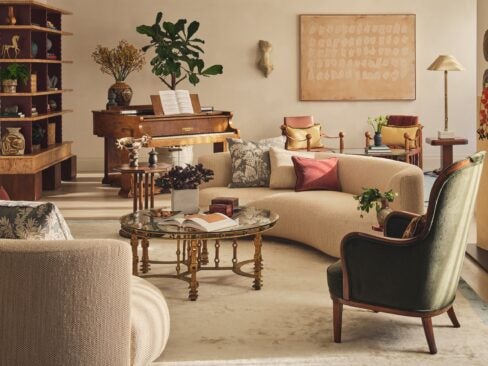

For the past five decades, Ralph Pucci International has carved its path in the retail and design landscapes with a singular vision: translating the body’s motion and human expression into sculptural form, firstly with mannequins, now with furniture and lighting.
When Ralph Pucci joined his father’s Manhattan-based business in 1976, the company didn’t make mannequins, it repaired them. “I remember growing up with the Pucci Mannequin Repair truck in our driveway,” he recalls. “My father would leave early, come home late. He was the salesman; my mother handled the finances. It was a true family business.” It was Ralph’s arrival that resulted in the business pivoting from behind-the-scenes service to front-of-window spectacle.
That first act of revolutionizing the mannequin saw Pucci’s sculptural figures abandon static, ladylike poses in favor of movement: diving, jogging, stretching. Mannequins on bicycles, sprayed high-gloss white, appeared on department store aisles like frozen performance pieces. “It almost became like a sculpture,” Pucci says, “and that became a real statement.”

Remaining cutting-edge was a crucial part of the company’s early success. “We kept moving with the times,” says Pucci. “Whether it was pop culture, sculpture or MTV, we reflected what was happening in the world.” This attitude led to collaborations with illustrators and artists like Ruben Toledo and Kenny Scharf — creative minds who had never worked with mannequins before but brought fresh, fantastical energy.
But as retail’s golden age waned and store design shifted from visionary to budgetconscious, the once-essential mannequin began to lose its cultural weight. “Retail used to be driven by creativity: from the chairman down to visual design,” Pucci says. “But eventually it became about cost. They said, ‘We can get these in China. They’re not as good, but they’re cheaper.’ That was the beginning of the end.”
The pandemic, which shuttered physical retail and accelerated the move online, delivered the final blow. Ralph closed the mannequin facility that had been humming for decades with skilled sculptors, sanders and painters, and turned the company’s focus toward furniture. “We had dabbled in it [furniture] 15 years ago,” says Pucci, referring to a celebrated collaboration with designer Vladimir Kagan. “But we were too busy with mannequins to pursue it properly.”

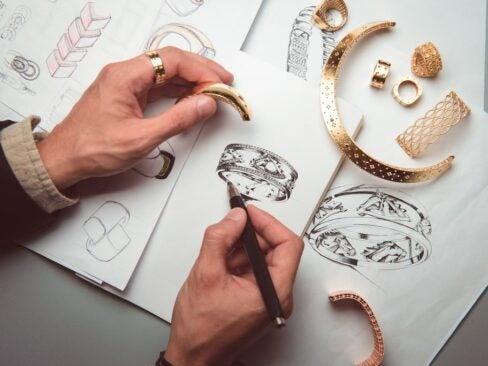
With time and attention finally free, Ralph Pucci International returned to the medium with renewed focus. “We produce and create furniture in a way that’s very different from traditional companies,” says Michael Pucci, Ralph’s son and now, along with his sister Nicole, an integral figure in the company. “A lot of times, it begins as a sketch on a napkin. We might be at lunch with a designer like Patrick Naggar, and he starts drawing. Ralph and I will pick one and say, ‘Let’s try it.’ Then we’ll go straight into the studio with Michael Evert [the master sculptor who has worked with the company for more than 40 years] and begin working in clay or plaster the same day.”
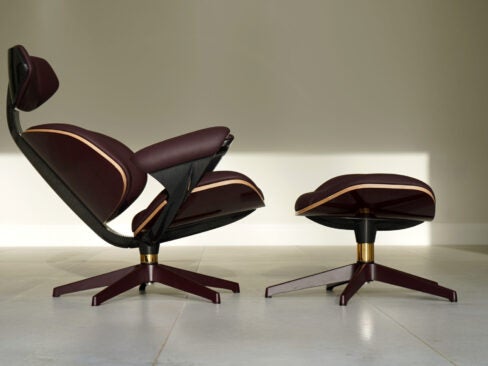
That immediacy, the sense of spontaneity and trust in the hand of the artist, is a throughline that runs from Ralph Pucci International’s mannequins to its furniture. “Even though it’s furniture, it still feels like sculpture; like a gesture,” Ralph continues. “The pieces are functional, yes, but they carry emotion. That chair you sit in, that table you use — it all starts with movement and feeling.”
What separates the company’s work from traditional design is not just the process, but the intent. A chandelier might evoke Brancusi, a stool might echo a dancer’s twist, but the result is never referential or derivative. “It’s always original,” Ralph insists. “It captures the spirit of the artist.”
Much of that spirit is embedded in the materials themselves, particularly plasterglass, a proprietary medium that imbues each piece with a raw, tactile honesty. “We love working in plasterglass because it shows the imperfections,” Ralph explains. “You can see the brush marks, the irregularities — it shows the hand of the artist.” That texture, he adds, gives the work life: “It moves. It’s not flat. It’s alive.”
Now, as the company prepares to celebrate 50 years in business, it finds itself in a rare position: honoring legacy while building something entirely new. Pursuing ongoing collaborations with artists such as Eric Schmitt, John Koga and Hervé Van der Straeten, and with a showroom presence in New York, Los Angeles, London and Miami, it continues to evolve. “The exciting part,” says Michael, “is that we’re still just getting started in this new space. We’ve built a foundation, but there’s so much more to explore.” For him, the future lies in preserving that same creative immediacy — remaining nimble, responsive and human. “We’re not interested in mass production. What we do is personal. That’s the magic.”