
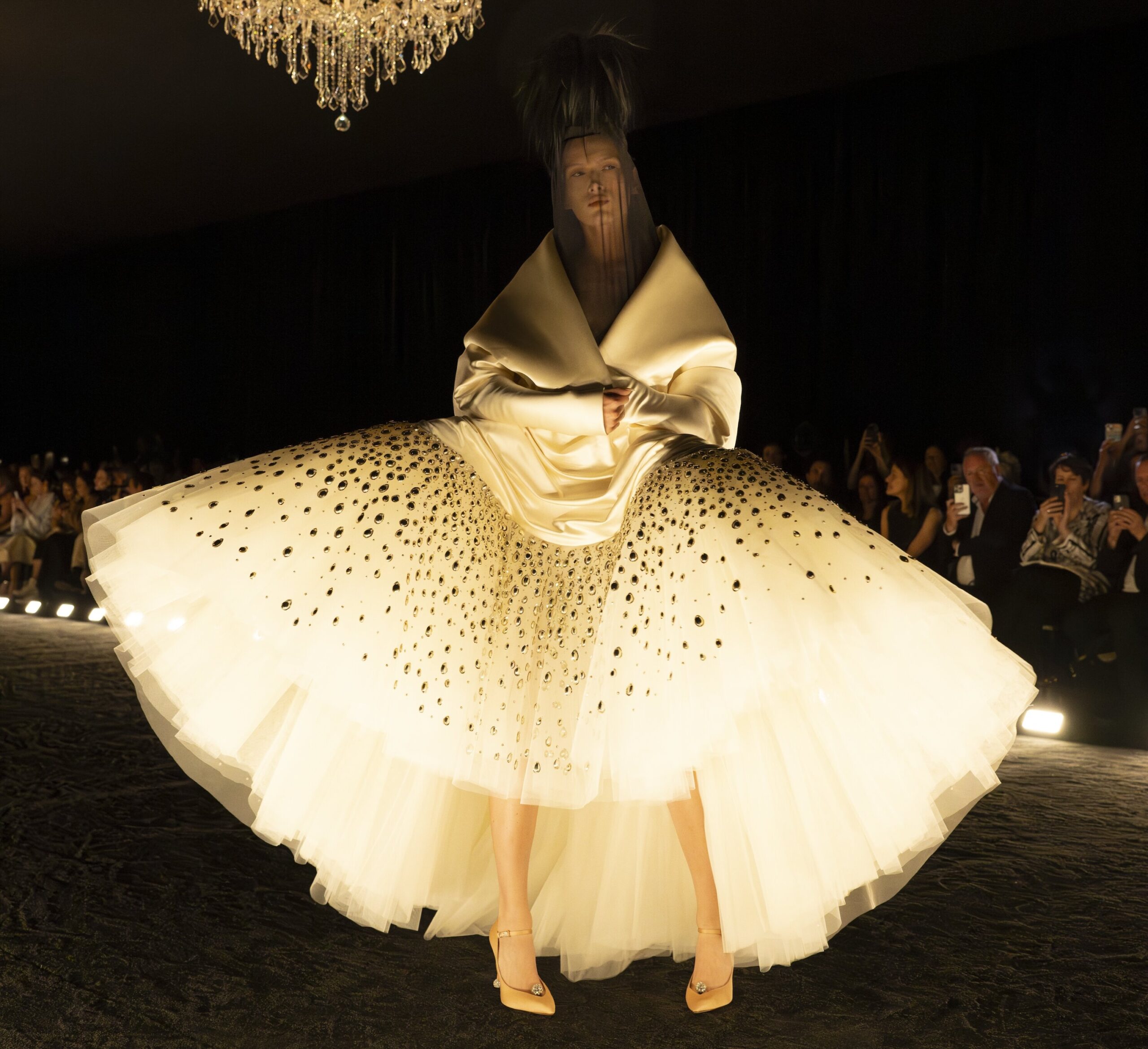
Elsa Schiaparelli is one of fashion’s most influential – and unconventional – designers, known for blurring the lines between couture, art, and surrealism. Later this month, London’s Victoria and Albert Museum will host the UK’s first exhibition dedicated entirely to her work.
Schiaparelli: Fashion Becomes Art traces the designer’s radical career, from her early experiments in the 1920s to her collaborations with artists such as Salvador Dalí and Jean Cocteau – and the continued evolution of the house under creative director Daniel Roseberry.
Ahead of the exhibition’s opening on March 28, we spoke with exhibition project curator Lydia Caston about Schiaparelli’s radical vision, her connection to London, and why her work still feels strikingly modern today.
Before we get into the exhibition, talk us through your position at the V&A
I'm a project curator, which means I mainly work on exhibitions. I first came here in 2018 to join the photography team working on fashion projects.
My first exhibition here was Tim Walker: Wonderful Things, working with the contemporary photographer who was inspired by the V&A collection to create ten new photoshoots to be displayed in the museum. I then moved on to other photography projects, often with a fashion focus.
The next one was Fragile Beauty: Photographs from the Sir Elton John and David Furnish Collection, which looked at their collection from the 1950s to the present and included around 300 photographs.
Then this Schiaparelli project came about. It's an exhibition that draws on expertise across the V&A museum. We have fashion and textiles curators working on it, an art historian, and a specialist on stage and screen. I'm also coming at it from a photography angle, but also from 1930s fashion interests. It's a nice project that ties all of these different things together.
What is the central curatorial vision behind the Schiaparelli, Fashion Becomes Art Exhibition?
We're looking at Elsa Schiaparelli’s design innovations and how she had an unconventional arrival onto the fashion scene. She grew up in Rome, then moved to London, and eventually to New York. She became a single mother, and by 1927, she was one of the leading names in fashion at the time.
We're exploring the beginning of her career and how she changed fashion forever – she still has an ongoing legacy today, and many fashion designers still reference her work. We're bringing the story up to the contemporary, looking at the house today with the work of Daniel Roseberry.
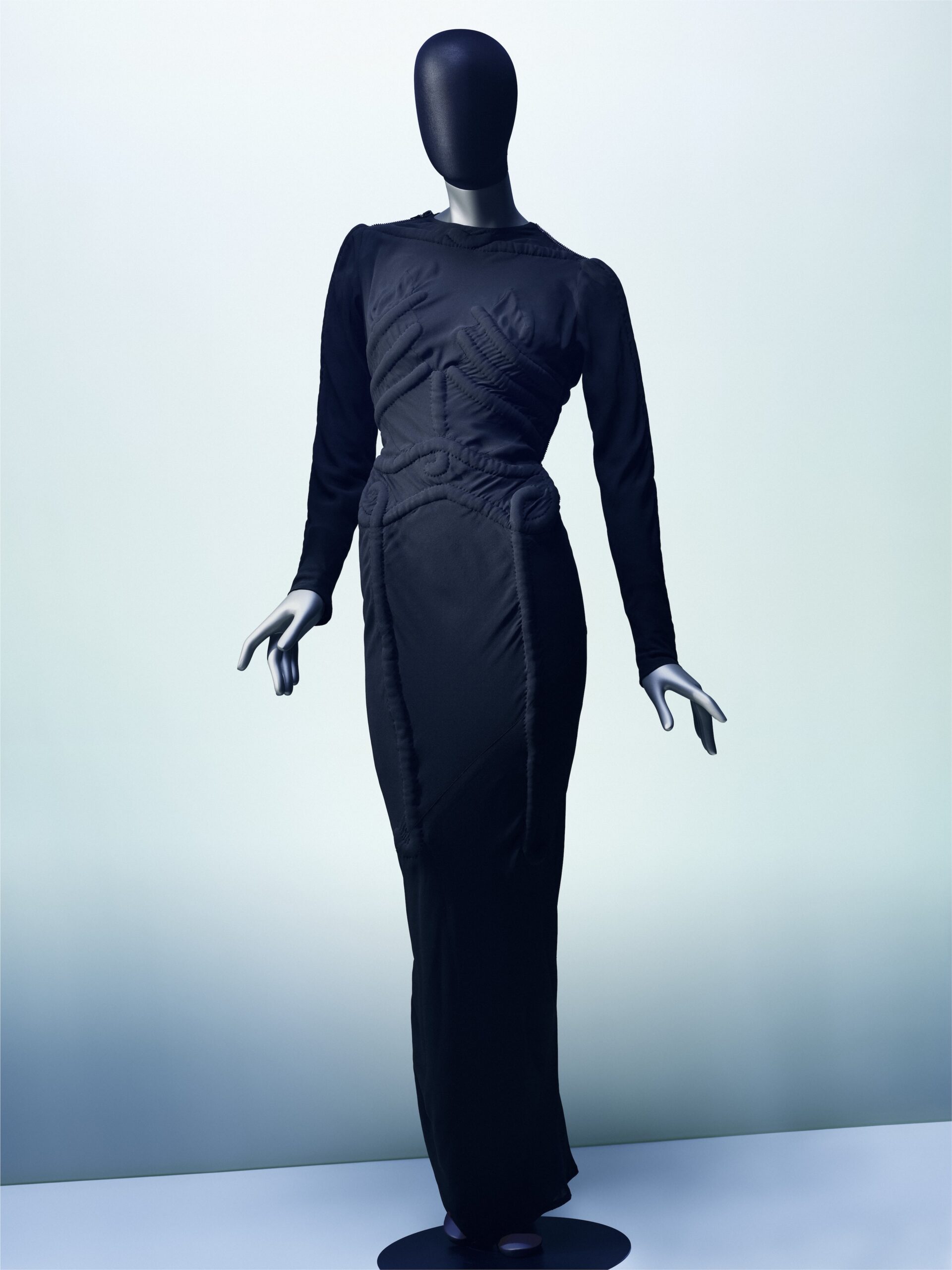
We’ll be celebrating some of her most iconic looks, some of which we hold in the V&A collection, particularly the Skeleton Dress and the Tears Dress. We’ll be highlighting these radical designs and her collaborations with artists – that's one of the central moments in the show.
We'll also ensure that visitors go home inspired and understand her important contribution to fashion history, because she's a name that deserves recognition today.
If you had to pick one piece in the exhibition as a personal favorite, which would it be and why?
It's hard. There are so many in the show. We have around 400 objects in total, which include buttons, jewelry, and beautiful couture gowns. I probably have a favorite in each section.
Some of the garments in our collection are wonderful. We have some of her most radical designs, as I mentioned – the Skeleton Dress and the Tears Dress – but there's also a wedding dress that we're showing in the exhibition. It was created in Schiaparelli's London salon for a wedding in 1934 at the Golders Green Synagogue, worn by Rosalinde Gilbert. I think it’s one of the only known examples of an Elsa Schiaparelli wedding dress today. It was a discovery that we made once we had already planned the show, and it's a great V&A connection because Rosalinde Gilbert’s art collection, which she owned with her husband, is part of the V&A collection today.
It's a beautiful dress with crinkly white fabric and gold threads – a metallic thread, so it shimmers at different angles – and a veil with orange blossom wax flowers and pearls on the crown. We know that Rosalinde Gilbert, the wearer, was also a seamstress, so when we looked at the dress with our conservation team, we found evidence that she altered it and wore it afterwards as well.
Schiaparelli designed the dress so that you could remove the sleeves after the wedding ceremony. The sleeves are now lost; we don't know where they are, but we think that Gilbert adapted the train, removed it, and then stitched it back on. It's got a great story – we know that she wore it again and again after the wedding.
Schiaparelli did create lots of capsule wardrobes in a way. She was thinking about practical, stylish, and radical at the same time.
Which piece do you think visitors will be most surprised by?
I think some of her day suits will be surprising to visitors. Those who know Schiaparelli might be familiar with her artistic collaborations – garments created with Jean Cocteau or Salvador Dalí – but some visitors will be surprised to see the simpler silhouettes, and how there's always a recognizable Schiaparelli signature, for example, with some of her buttons.
We have a section called Pour la Ville, which looks at daywear and garments for the city – beautifully tailored suits that make you look twice. There's a suit that looks like it has woven fabric, but it's actually printed fabric, and then when you look closely, it has shimmery beetle buttons. Even though it's a conventional silhouette, it still would have stood out in city crowds. Visitors will be excited to see that.
And, of course, some of Daniel Roseberry's garments. Visitors will be surprised at the ways he's taken design code from Elsa Schiaparelli and transformed it for a contemporary audience today.
Where do you think Daniel Roseberry's direction deliberately pushes Schiaparelli's ideas somewhere new?
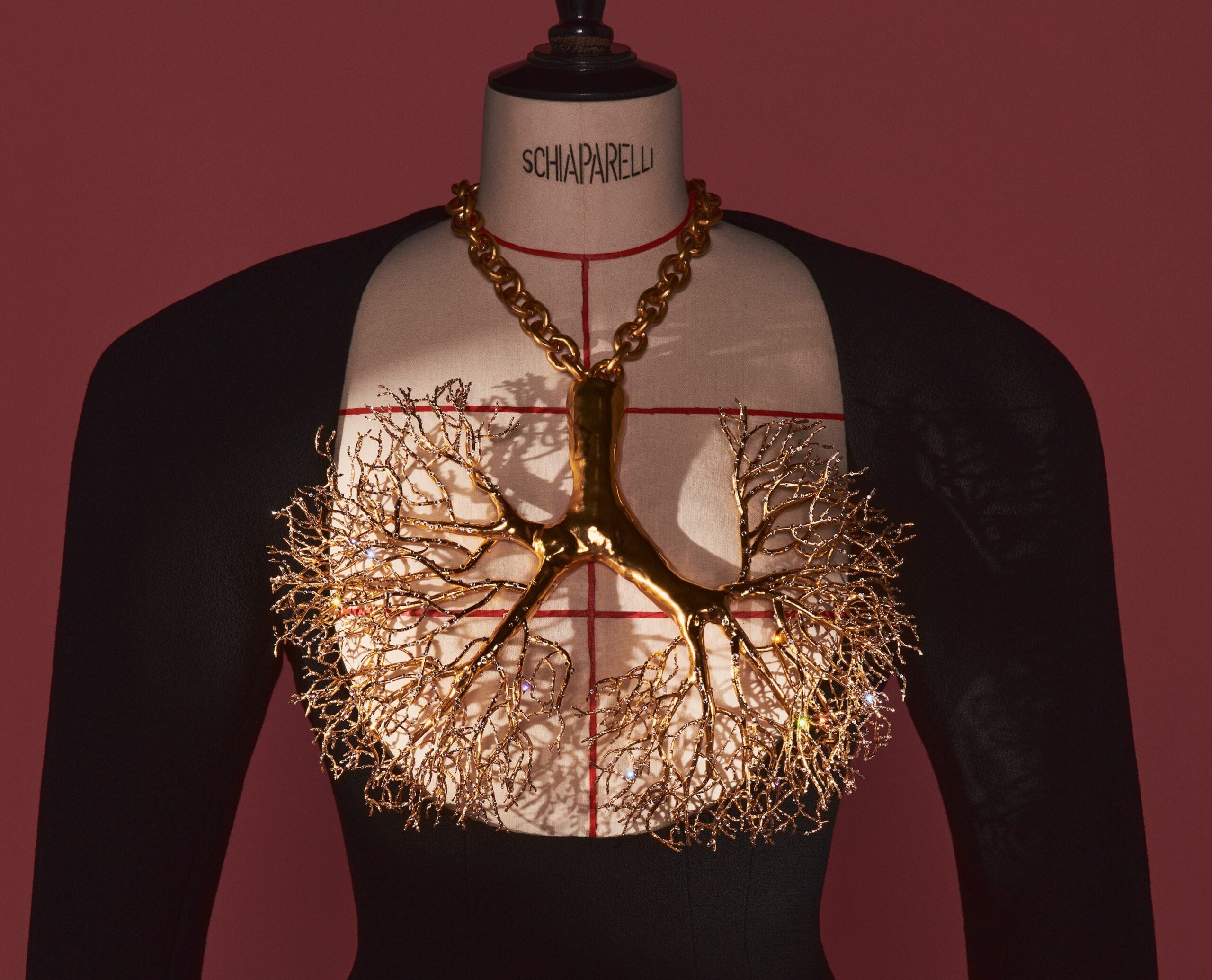
Without giving too much away, we will be showing quite a few of his garments, especially ones that are in dialogue with Elsa Schiaparelli. Sometimes he takes motifs – for example, he's done versions of the Skeleton Dress with padding and protruding bejeweled ribcages on gowns – and uses many examples of anatomy and surrealism with lips, eyes, and noses.
But sometimes it's more the spirit of Schiaparelli – the idea of wanting to break rules, to break conventions, and to push boundaries, whether through sculptural, unexpected silhouettes or through the materials that he's using.
There's a gown with a cut-out keyhole in the center, made of plastic – almost like a Play-Doh-like material – but from a distance it looks like feathers. It's a white, long-sleeved gown worn by Dua Lipa for one of their couture shows. When you get closer, you wonder: is it shell, rubber, or plastic? It's interesting how he's able to convey Elsa Schiaparelli’s spirit and the idea of making people look twice and think about the garments.
This is the first exhibition in the UK devoted entirely to Elsa Schiaparelli. How did that context shape your approach, and were there aspects of her work you felt especially important to foreground for a British audience?
We're not only introducing her and celebrating her work, but there's also new research that's been done on her London house. She opened her London salon in Mayfair, 6 Upper Grosvenor Street, in 1933, and closed it in 1939. That's all new research, which hasn't been explored in other Schiaparelli exhibitions before – in Paris, Australia, or the US.
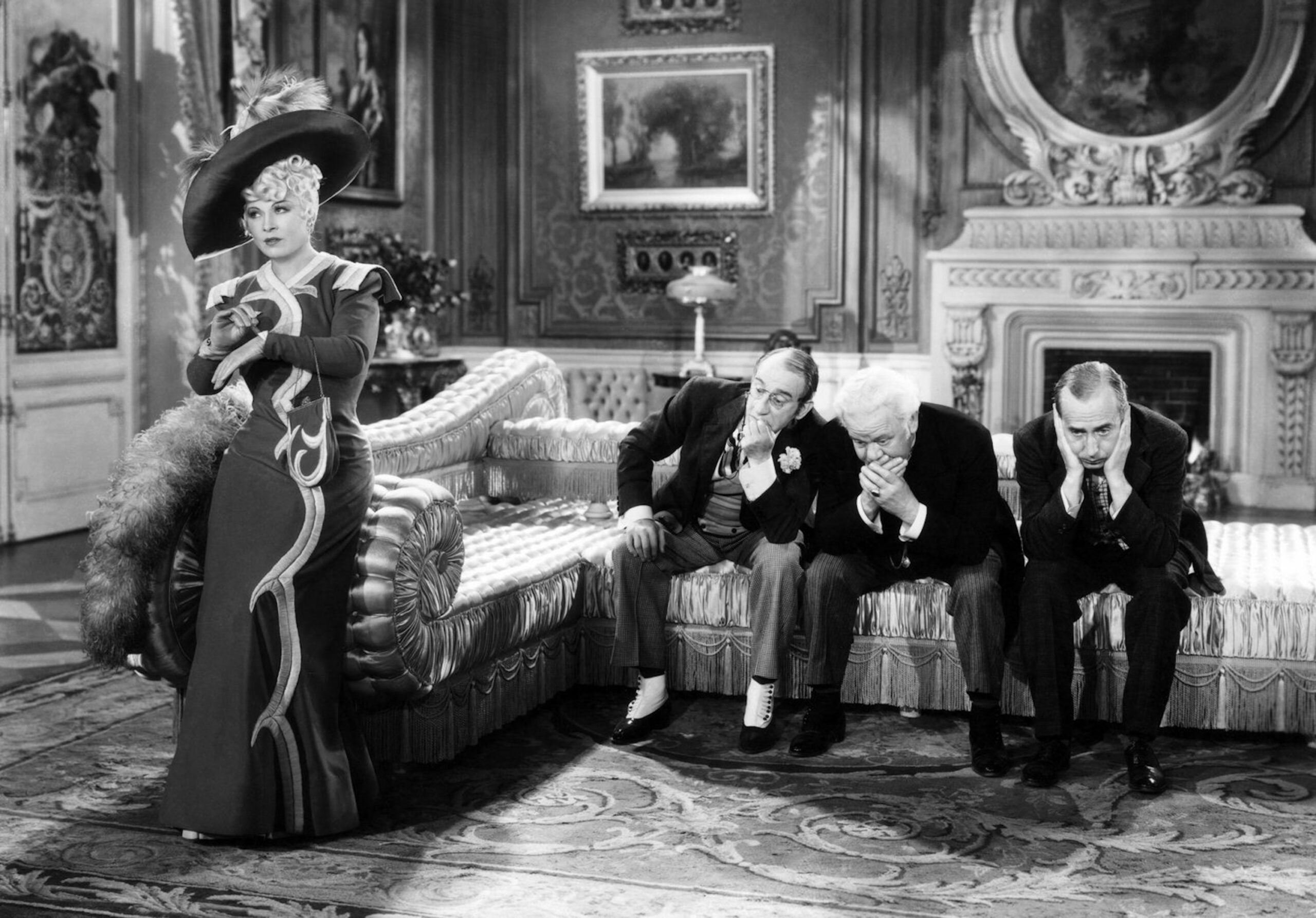
We'll be showing one whole section, within the section called Beyond Paris, which looks at her work for stage and screen, where she contributed to costume design for film and stage, particularly on the West End. We'll be showing some examples of her work there, as well as some of her work for important clients.
There's a client called Frances Farquharson, for example, who was the British editor of Harper's Bazaar at the time, and wore beautiful black Schiaparelli tailored suits made at Schiaparelli London. All of these elements bring Schiaparelli's love for Britain, where she spent so many years. In her autobiography, she speaks about how much she loved British material, how she loved going to the pub in Wapping in London.
It’s a great story that we're excited to bring to visitors. Although we thought at first the garments might be different from the Parisian garments, they're beautiful, striking, and sometimes surprising. They still convey this surrealist spirit.
Schiaparelli is often described as blurring the boundaries between fashion and art, as seen in the exhibition name. How does the exhibition explore the relationship between fashion and art?
We're showing some of our garments from our collection, which were created in collaboration with Salvador Dalí. They had such a strong collaborative relationship where they fed off each other for ideas. The Skeleton Dress, for example, will be shown alongside an illustration of a sketch where Dali writes, “Dear Elsa, I really like the idea of bones protruding from the body on a dress.” We'll be showing the illustration, as well as the garment for the Tears Dress.
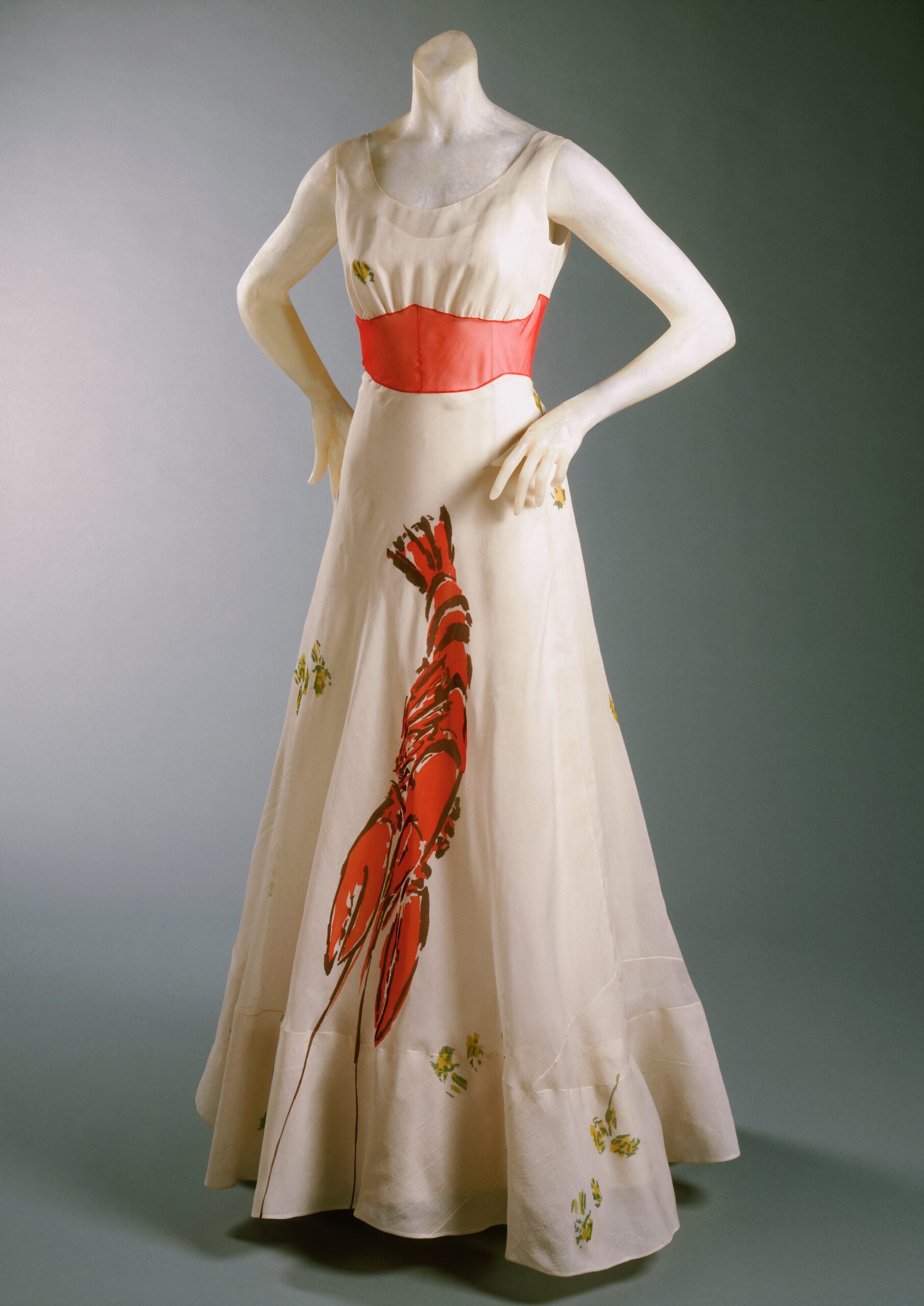
We will also be showing one of Dali’s paintings, Necrophiliac Spring, for the first time in a Schiaparelli exhibition, as well as some of their early collaborations, which started in 1935 with makeup compacts that looked like telephone dials.
Sometimes it is purely her taking motifs from discussions with Dali or from paintings or from Jean Cocteau, and other times you see recurring conversations. For example, we can trace these telephone compacts to Dalí's Lobster Telephone, and then also the Lobster Dress that she designed in 1937, which was worn by Wallis Simpson. It's not just thinking about her as someone who collaborated with artists, but also as a surrealist and an artist – fashion just happened to be her medium.
Also, with the London story, one of our colleagues who worked on the exhibition, an art historian and paintings curator, found that Schiaparelli's London house was one of the first surrealist venues in Britain. Her story tracks with the arrival of British surrealism. We'll be showing paintings, objects, and sculptures created for some of the first surrealist exhibitions in Britain, all tied to Schiaparelli in some way.
Collaboration was central to Schiaparelli's practice. How did you decide which artistic partnerships to include? What do those collaborations tell us about her creative philosophy?
As we were doing the research, we found more and more collaborations. Some that are well-known, like Dalí and Cocteau. They’re important, and I think people will be excited about them.
We're also fortunate to work with my colleague Rosalyn McKeever, who helped secure important art loans, like the Lobster Telephone from the Tate and the painting that I mentioned (Necrophiliac Spring), ensuring we foreground the art as well as the garments. With the British surrealism story, that was an element of focus, which is why we decided to show some of those garments in conversation with British surrealist artists such as Eileen Agar, John Banting, and Lee Miller.
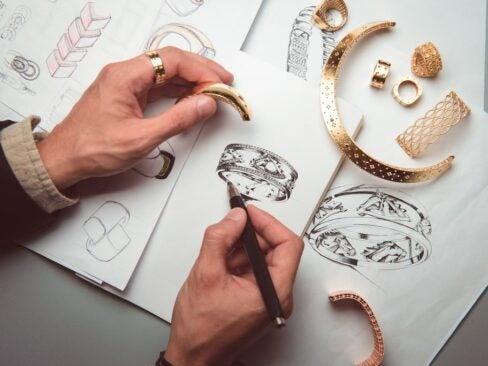
Some of the collaborations aren't just based on garments, but also sometimes on jewelry. She commissioned and also had artists such as Jean Schlumberger, Dalí, Cocteau, and Elsa Triolet designing jewelry for her, which she sometimes sold in the shop. We'll have a whole section looking at her jewelry collaborations, and another section just on perfume.
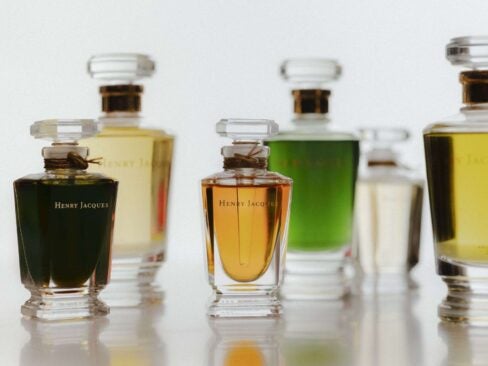
Her perfume bottles are incredible, and visitors are really going to enjoy them. Artists designed some of the packaging, advertisements, and bottles. One of her most famous perfume bottles is Shocking from 1937, designed by Argentinian surrealist Leonor Fini. It's shaped on the bust of Mae West, which was the bust dummy in Schiaparelli’s atelier at the time.
If you think of even Jean Paul Gaultier bottles, Schiaparelli was, in some ways, the precursor. It’s exciting for people to see how her collaborations went from big to very small perfume bottles and even tiny buttons.
How do you see Schiaparelli's designs in everyday life?
We call her the first punk in some ways. We can trace her heritage and design codes all the way up to McQueen, Vivienne Westwood, and even J.W. Anderson.
She was radical, and she gave designers the key to thinking creatively, to break boundaries. When we think of the Skeleton Dress, in the same way she'd have protruding zippers across
garments, punks might use safety pins. This is something we've been discussing as a team, thinking about how her design conventions have continued to impact fashion today. Also, [we see] her entrepreneurial spirit. She started in 1927, and by 1935, she was on the cover of Time Magazine. She was the first female fashion designer on the cover, and she was really leading Paris couture during the interwar period. She was, in many ways, the first creative director – in the way she sold herself through her perfume range, the way she advertised her garments, perfumes, and jewelry. She was a pioneer in that way, and she redefined the way we think about a creative director.
What role does humor play in Schiaparelli's designs, and how can visitors engage with this in the exhibition?
Through the exhibition design, visitors will get a sense of her creativity and humor, and also that of Daniel Roseberry’s. We've been working with a great team called Nebula Works; they are architects by practice, but also exhibition designers, and they've embraced her sense of humor and this idea of surrealism.
They've been inspired by black-and-white photographs from the 1930s to create the exhibition design and the idea of making you look twice. There are moments where you might see one garment and then see it again from a different angle. We will have mannequins posed in unconventional ways – some seated or held at the height – and there'll be interesting audiovisual and dynamic lighting design. Elements of Schiaparelli's design, like the bug buttons, are also shown in the exhibition design in different ways. The designers have been inspired by the garments, and that's something that we think visitors will like engaging with.
Is there anything else you’d like to share about the exhibition that we can expect?
Another thing to expect is this element of surprise and this new research – the area of stage and screen, which hasn't been explored much before. She was designing costumes for films such as the 1952 Moulin Rouge!, and a film with Mae West as well.
For stage and screen, she reached huge audiences with one production, shown over several months, with an audience of around 450,000. More people saw her garments [this way] than her couture presentations or fashion photography. It's exciting that we'll be able to show some of these. There will be two evening suits worn by Marlene Dietrich, and then a costume worn by Mae West for her film Every Day's a Holiday.