

Few names in whisky have an aura quite like Karuizawa, the Japanese ‘lost distillery’ which ceased production in 2001. Its big-boned, heavily-sherried malts have set many records at auction, fuelled by the knowledge that chances to taste it are diminishing all the time.
Karuizawa is usually sold by the bottle – but on March 10 Christie’s is auctioning off two entire casks taken from the collection of prolific collector and former co-founder/owner of The Whisky Exchange, Sukhinder Singh. Both casks were filled in 1999, just before the distillery closed. Each one amounts to around 420 bottles and carries a reserve price of £2m ($2.7m).
“I discovered Karuizawa in 2006 when one of my friends bottled some, and it was, at first, quite a shock,” recalls Singh. “It didn’t have that elegance I associated with Japanese whiskies like Hibiki, Yamazaki. It was heavy, heavy, heavy, sherry – like old-style Macallan on steroids. But that richness and spice was also very balanced. The spice had something very distinctive and oriental about it that I absolutely loved.”

Almost all the Karuizawa inventory was aged in sherry casks, which give it its robust style. “But what really makes Karuizawa, Karuizawa,” says Singh, “is the microclimate in which it was matured – it’s cold in winter and hot in summer, but, importantly it’s also humid. That’s what gives it this warmth and richness and spicy note and strength that’s just so unique.”
In 2012, the opportunity arose to buy the remaining stock, so Singh travelled to Japan and bought “just under thirty” casks. “We were the last people to visit Karuizawa – they began demolishing the distillery the very next day.”
See also: Europe’s Most Famous Wine Dynasties Just Released an Ultra-Limited Case
After a brief stint in the warehouses at Japan’s Chichibu distillery, the casks were shipped to Scotland where they continued to age, before being bottled as Whisky Exchange exclusives. (The two remaining casks now reside in bond at The Tormore distillery in Speyside, which Singh’s company Elixir Distillers now owns.)
Early Karuizawa releases were priced “around £200 (approx. $200)” but soon spiralled and within just a few years those same bottles were fetching £10,000-£15,000 (approx. $13,500 to $20,300) at auction. In 2020 a 52-year-old Karuizawa from 1960 set a new record for Japanese whisky when it sold for £363,000 (approx. $491,000) at Sotheby’s. “Prices got so crazy that people were actually afraid to drink it, which was a problem,” says Singh.
What was behind this mania? “It was just really great timing. Japanese whisky was on fire, the whisky market was on fire, it was a lost distillery and sherry cask. And the flavors were extreme, but lovely. The whiskies had beautiful labels. And people just fell in love.”
The great irony is that Karuizawa had originally closed because it was a bit of a flop.

“They had tried doing a single malt but the Japanese didn’t take to it. Back then, in Japan, it was all about Scotch. So much of it just ended up going into cheap blends.”
Part of the problem, feels Singh, is that the original Karuizawas were “bottled far too young. For me sherry [i.e. sherried malts] really needs at least fifteen to eighteen years to integrate with the cask. A lot of the Karuizawa we [The Whisky Exchange] bottled was thirty or forty years old.”
See also: Interesting Wines To Order At Dinner, According To Sommeliers
The two casks in the Christie’s sale are youngsters by comparison, at just 26 years old. “And they’ve still got at least 10 years left in them before they need to be bottled,” says Singh. “They’ve still got the strength, the freshness, the fruit. They can last a long time.” The Christie’s deal includes storage in the Tormore warehouses until 2029.
Both casks were filled at the same time – yet they are strikingly different in style.
Cask 6195 (61.8 percent ABV) is golden in color, rather than the deep amber Karuizawa fans might expect. And it’s unusually supple and fruity, even quite fragrant. “I get juicy melon, a lot of pistachio, a green note that’s maybe even a bit matcha,” says Singh. “It’s softer, mellower, but it still has lots of energy.” The finish is long, perfumed and quite oily, with sweet lebkuchen spice that really flowers with a drop of water.
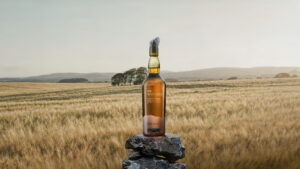
Cask 888 is lower-strength, at 57.7 percent ABV, but it comes across as much more powerful, with all the deep color, breadth, and tannic presence that is the Karuizawa signature. “I find its richness and spicy fruit quite wintry,” says Singh. I get black chocolate, raisins, orange marmalade, ginger cake, and a cooling hint of bittermint. There’s a lot to unpack. Singh continues to collect whisky – he estimates he owns “around 200 bottles” of Japanese whisky in all, including early Suntory and Nikka vintages, Chichibu single casks “and over a hundred different bottlings of Karuizawa across a number of vintages.” And that only represents “2.5 percent of my whisky collection.” So, a couple of casks surely won’t be missed.