


It’s a Wednesday night during the week of Art Basel in Miami and one of the many dinners taking place across the city is unfolding on a rooftop in the Design District. The Florida weather has behaved, and the tropical showers that punctuated the previous days have resolved into a clear, still evening.
All of the 100-odd guests – a cultured crowd of creative leaders from across the US and Mexico, including the likes of artist JR, Serpentine Galleries artistic director Hans Ulrich Obrist, and Art Basel CEO Noah Horowitz – are turned towards the head of the table where an elderly gentleman sits between two large screens.
Speaking in Italian-accented English, he softly gives instructions to his assistant who tweaks the display showing the channels of a multi-track mixing desk. As the first plates are cleared (risotto verde with citrus, polenta with squash blossoms), he brings up one fader, a pulsing kick drum echoing out into the warm night air.
Over the course of the next 10 minutes he will painstakingly reconstruct I Feel Love — the electronic disco epic that he made for Donna Summer in 1977 under his stage name, Giorgio Moroder. The question, as he describes it, was always this: “How do I create something that has never been created?”
See more: Marc Puig, The Power Broker of Perfume, Sets His Sights on Fashion Month
For tonight’s hosts, the Zegna family, it’s a question that has increasingly come to shape their week here in Miami, their outlook, and their brand. Zegna’s story begins in 1910, when Ermenegildo Zegna — great-grandfather of the current owners — founded a wool mill in Trivero. Around 50 miles northeast of Turin, this was a center for fabric production and a physical manifestation of the Zegna brand.
Ermenegildo built the SP232 road that connected Trivero to the wider world; he created the Oasi Zegna, a public forest of more than half a million trees. A school, hospital, pool, and ski resort all followed for the company’s workers. The brand has talked of how the founder “was radical not only for what he created, but for how he thought… he believed that building a business also meant building a place, a community, and a future that extended beyond the individual.”
Ready-to-wear began in the 1960s, with made-to-measure following a decade later. The ‘80s saw the growth of boutiques in key European locations, with a pioneering store opening in China in 1991.
While things have evolved from a business perspective – in 2021, Ermenegildo Zegna Group went public at $3.1bn, going on to acquire Tom Ford and Thom Browne, while stores have proliferated from Saudi Arabia to Sydney — in many ways the label’s power derives from a slow, considered consistency. A recent corporate redrawing has seen Edoardo and Angelo Zegna, part of the fourth generation of the family, step up as co-CEOs.

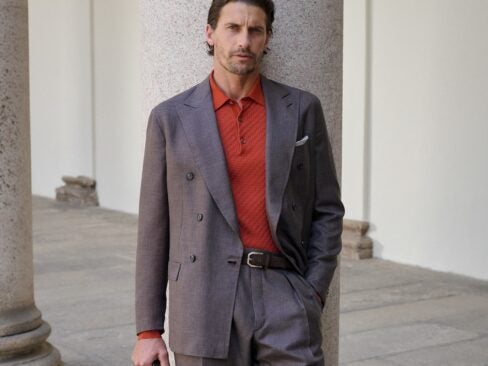
Since spring 2019, the formality of the brand’s offering has reduced, crystallizing into a series of modular, gently utilitarian collections, built on tactile fabrics and finishes and a sort of unstructured, if-you-know-you-know low-key luxury. It’s the sort of clothing that men with numerous global homes buy in volume, ready to be stepped into whether at a funding round in the UAE, Milan for fashion week, or, as in this case, Miami for Art Basel.
At this stage of its evolution, the challenge for Zegna is less a case of how it maintains quality and consistency, and more about how it protects its ethos in a world which, in many ways, runs counter to it. The fashion industry, like most others, is obsessed with metrics, speed, and an always-on mindset. When you’re a quiet, considered, design-led family, who’ve openly talked about a desire to be the ‘slowest’ brand on the market, what do you do? You go to the Villa.
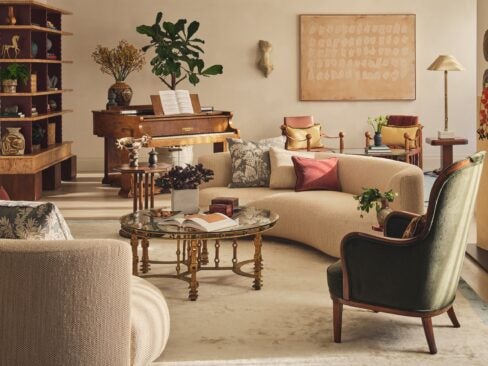
Stepping out of the elevator for an early glimpse of Villa Zegna, the first thing you encounter isn’t clothes. A warm, vegetal scent fills the air; a low, ambient soundtrack of birds and insects gently hums; vast paintings by emerging nature-based artist Sam Falls frame the room.
This is the latest iteration of a temporary, location specific conceptual space that Zegna has activated since May 2024 in Shanghai, New York, Dubai, and now Miami. Each Villa is hinged around a suitable cultural event or theme – and the brand’s ongoing multi-year relationship with Art Basel, announced in May 2025, underpins its presence here.
See more: Inside Véronique Nichanian’s Remarkable Run at Hermès
In short, this is the next frontier of personalized shopping: not merely a retail moment, but what Zegna describes as “a discreet, highly curated environment where guests are invited to experience the brand through art, dialogue, and hospitality.” Over the days ahead, in the region of 100 individuals will have two hour, one-on-one sessions at the Villa, shopping an exclusive made-to-measure collection, loosely grouped by color palette. These items will be delivered four to six months later.
There’s a remarkably extensive selection: the gently rumpled, unstructured suiting that dominates Zegna’s SS26 collection occurs in a number of finishes, most notably a beautiful rust-pink houndstooth, paired with a chic take on the Harrington in a matching terracotta. The standouts are nicely un-flashy: Zegna’s ll Conte (a versatile blazer-meets-chore jacket) is tweaked in different fabrics and finishes including Zegna’s superfine Vellus Aureum wool paired with alligator; a matching weekend bag, pouch, and belt use a smooth, tactile crocodile in a prehistoric green.
There are quietly innovative super-soft fabrics, including a specially treated water-repellent cashmere. Whole outfits previewing Spring/Summer 2026 appear here before anywhere else, and hang together on the rails paired with a crib sheet showing them on a model.
The colors that dominate – earthy tones, near neutrals, deep stony shades with the occasional flourish of blue – make the whole range feel interchangeably cohesive. Guests will also be privately toured around Art Basel and galleries such as the Rubell Collection; they will network over cocktails, with the trip culminating in an exclusive, ultra-private dinner on the Wednesday night.


Zegna isn’t the first luxury brand to create experiences for its most prized customers – Chanel has staged private exhibitions like 2023’s ‘A Journey into the Allure’ in Hong Kong, Bulgari created events around its Serpenti collections, Stefano Ricci leans into adventure travel with trips to far-flung locations for collection launches – but what is different is the idea of an entire conceptual third space that can iterate in different times and places: a sort of menswear TARDIS, materializing in the world’s cultural capitals.
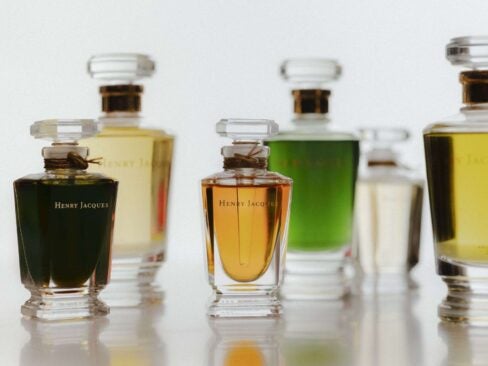
The room at Villa Zegna is a showstopper in its own right – a pink derived from the rhododendron flowers in the Oasi Zegna flashes throughout, with the space opening out onto a sundrenched roof terrace attended by whiteclad staff. I enjoy the way the light catches the handmade, layered, Venetian glass bottle of the richly colored Masterpiece fragrance (just 500 individually numbered bottles available at $3,500 a time) and the small printed instruction card that arrives alongside a double espresso: “Stir the coffee clockwise three times… Using the back of the spoon, paint the rim of the cup…” It’s a very Zegna touch.
These few days in Miami illustrate an interesting challenge for modern brands. Quantifiable aspects of a product can only be pushed so far, and the world’s best manufacturers are already in the realms of marginal gains.
See more: “Vuitton Is Not a Fashion Brand”: Why LV CEO Pietro Beccari Believes Luxury Must Take Risks Again
Scarcity of product can be manufactured, but cultural scarcity is where the real value lies. Especially at a time where human knowledge, experience and interaction have become harder to achieve, connecting people around art and culture, in a moment that you can’t buy your way into, feels more mature, meaningful, and longer-lasting: A sense of luxury that goes beyond seasons and collections.
This approach also underpins Zegna’s long-standing work supporting everything from artists and publishing to rewilding projects and the flowerbeds of Piazza Duomo. “Luxury today is not about having more; it is about having fewer moments that truly matter,” says someone from the brand to me during the trip. “Experiences that cannot be rushed. Places that invite people to slow down. Objects that improve with use rather than expire.”
With Miami flooded with art and design for the duration of Basel, the city makes the perfect backdrop for this kind of experience – and the people who are drawn to it. As we walk around a preview of the fair, one seasoned art-watcher tells me that one of the signs of the truly serious buyer with significant capital (both cultural and financial) is what’s on their feet: the Zegna Triple Stitch sneaker.
Back at the dinner, as the last plates are cleared, the party moves through to the terrace and breaks out into smaller groups over lychee martinis. Nobody’s taking selfies or updating followers or livestreaming, and there’s no product front and center; most guests are moving at that level of industry-insider anonymity that operates more quietly.
Sartorially, the vibe is quiet-luxury-via-the tropics: trousers are wide and loose, Zegna’s Il Conte jacket is a popular choice, shirts are generally unbuttoned to near the midpoint. Formal suiting has been almost entirely displaced even among older guests, although for the evening the color palette stays monochrome.
For the next four days, this space will be a steady hum of aesthetic activity, curation, and selection. Guests will take their time to create and choose items that should live with them for years to come. Amid the paintings, books, furniture, and flowers, this isn’t just a room to shop but a restatement of Zegna’s first principles: that luxury is about culture, connection, and something more human.